Solar Panel Labels Describe More Than One Thing
A quote might describe its panels as monocrystalline, n-type, bifacial, half-cut, and all-black at the same time. Those words are not competing choices on a single menu: they describe material, electrical design, construction, and appearance. Sorting them into the right categories makes it easier to understand what you are buying and whether a claimed advantage will help on your property. A space-constrained roof may benefit from higher electrical output per square foot, while a portable setup may place more value on weight and handling. For a permanent home installation, the strongest comparison connects the exact module with its installed layout, expected energy production, service support, and total system cost. The panel family provides context, but it cannot determine the quality of the complete proposal by itself.
A: Yes. One term describes silicon structure and the other describes two-sided collection.
A: No. Many thin-film products are rigid modules supported by glass.
A: Appearance alone cannot establish electrical output or system production.
A: They may have different module efficiencies and construction dimensions.
A: It should also be assessed for the roofing function it replaces.
A: Rear output requires useful light access and a credible site-specific estimate.
A: Assess their condition and actual production before considering replacement.
A: Manufacturing, packaging, documentation, and support also matter.
A: Only a product approved for that application and installation method should be considered.
A: Compare complete installed scope and the useful output each proposal is expected to deliver.
Monocrystalline Silicon: Two Actual Module Comparisons
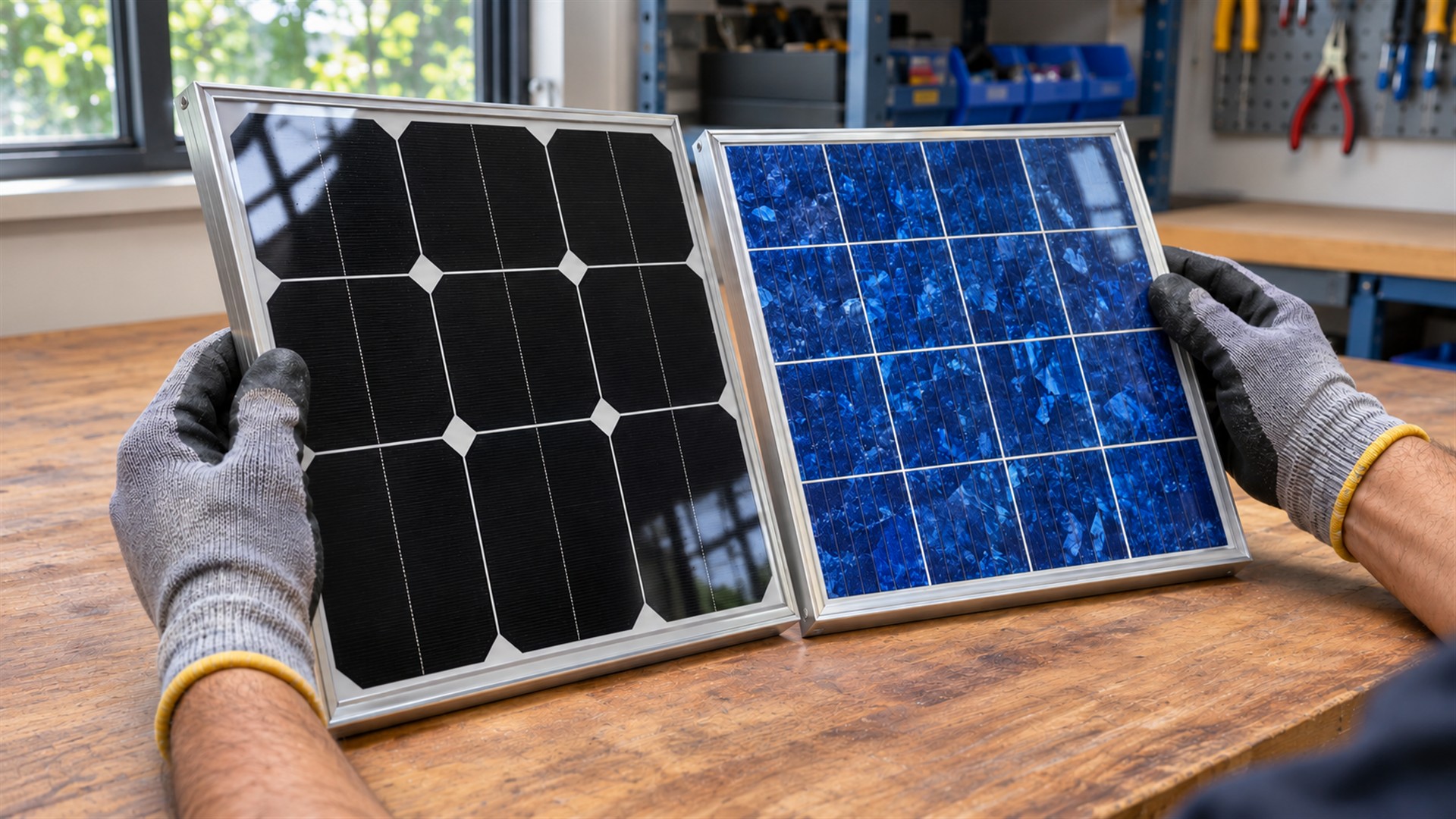
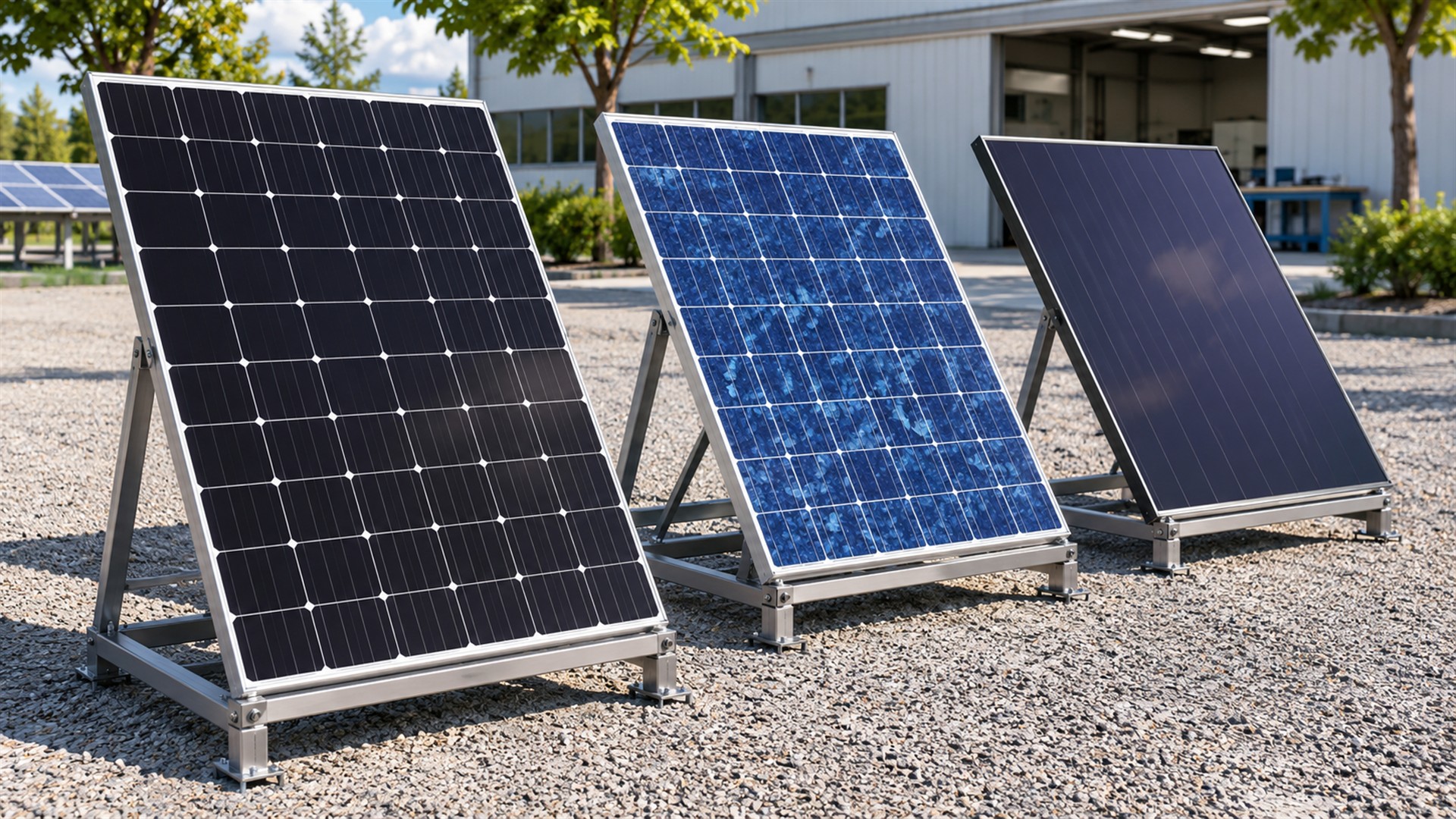
Monocrystalline cells use silicon with a continuous crystal structure, but their architecture and packaging still vary. Manufacturer documents checked on November 12, 2026 illustrate the difference: Qcells’ North American Q.TRON BLK M-G2+ 440 is a 440-watt n-type TOPCon module with at least 22.5 percent module efficiency. Its current North American data sheet gives dimensions of 1,722 by 1,134 millimeters. It is a residential example, not a reference for every Qcells product.
REC’s US-listed Alpha Pure-RX uses heterojunction cells; the REC470AA Pure-RX power class is rated at 470 watts and 22.6 percent efficiency. REC specifies a larger 1,728-by-1,205-millimeter footprint. Its extra 30 watts therefore does not represent a large efficiency leap over the Qcells example: the efficiencies are close, while the physical areas differ. Both are mono products with different architectures and electrical characteristics.
For a compact roof, test their actual rectangles against vents, access and required clearances before choosing by wattage. Qcells’ smaller footprint might fit a location that rejects the wider REC panel, while REC could provide more capacity where the same panel count fits. These are manufacturer-listed comparison candidates, not confirmation of installer stock or a universal recommendation. Obtain a regional offer and compatible electrical design for the exact model.
Polycrystalline Silicon: Evaluate the Actual Offer
Polycrystalline, also called multicrystalline, cells contain multiple silicon crystal regions. They often have the familiar blue, textured appearance seen on older installations. Compared with many modern mono products, older poly modules commonly need more surface area for a given rated capacity. This makes roof layout especially relevant when comparing existing or discounted stock with current alternatives.
The practical issue is availability and project fit, not a blanket judgment that poly panels cannot work well. A functioning existing array does not become unproductive because newer technology exists. For a new purchase, examine stock provenance, condition, warranty eligibility, model documentation, and installer willingness to support the equipment. An inexpensive module can still lead to an expensive project if its dimensions, electrical characteristics, or replacement availability complicate installation and service.
Thin Film Covers Several Different Materials
Thin-film photovoltaics deposits very thin semiconductor layers onto a supporting surface rather than assembling conventional silicon wafers. Cadmium telluride and copper indium gallium diselenide are examples of distinct thin-film material systems. Their construction and commercial applications differ, so the term should not be treated as a promise of one efficiency, one weight, or one price. The Department of Energy’s cell overview describes these material families and the difference between wafer-based and deposited semiconductor approaches.
Some thin-film products are rigid glass modules used in large projects, while particular flexible products serve portable, curved, or weight-sensitive applications. A flexible appearance does not establish suitability for a roof attachment method, repeated bending, or permanent weather exposure. Check the product’s approved mounting instructions and the complete assembly’s durability. A lightweight portable panel and a utility module may both be thin film while being designed for very different jobs.
For homeowners, access to a qualified installation channel matters as much as the material’s theoretical appeal. A product may be common in utility construction without being readily offered for a small residential roof. Ask whether the proposed inverter, mounting system, electrical approvals, and warranty support are established for the exact module. Those answers are more useful than assuming a thin-film label automatically means easier or cheaper installation.
Bifacial Describes Collection From Two Sides
A bifacial module can generate from light reaching its front and rear surfaces. It is a construction and performance characteristic rather than a separate semiconductor family. Rear contribution depends on actual light access, surface reflectance, mounting clearance, row spacing, and obstructions. On a low-clearance installation above a dark roof, the rear may receive little useful illumination. On an appropriately designed elevated array, rear collection may be more valuable. Require a site-specific production assumption instead of adding an advertised bifacial gain percentage to every roof proposal.
Cell Architecture Terms Belong in a Second Layer
Labels such as PERC, TOPCon, heterojunction, and back contact describe approaches to reducing losses or arranging cell structures and contacts. They can help explain why products within the same silicon family perform differently. They are not complete measures of module quality. Manufacturing consistency, packaging, qualification, and field support still determine whether an attractive cell design becomes a dependable installed product.
Likewise, n-type and p-type describe semiconductor characteristics, while half-cut describes a cell-division and interconnection approach. A buyer does not need to become a semiconductor engineer to compare them. The useful next step is to ask which documented module-level benefit matters on the proposed site: more watts within a fixed area, a different temperature coefficient, a particular warranty commitment, or improved behavior under a defined electrical condition.
Efficiency Is About Area, Not Automatic Savings
Module efficiency measures electrical power output relative to the sunlight falling on the module’s stated area under specified conditions. Higher efficiency can allow more rated capacity within a constrained footprint. It does not mean that a system with a higher percentage necessarily produces more annual electricity than a larger system using lower-efficiency modules. Layout and total installed capacity must be considered before interpreting the percentage as a project advantage.
Consider two hypothetical modules with equal 400-watt ratings. If one is smaller, it has greater power density and may fit a difficult roof better. If both systems can install the same number and experience similar conditions, the more efficient module does not automatically receive more sunlight or create extra rated watts. The value appears when its size, thermal behavior, or another measured difference improves the actual design.
Annual energy estimates add the missing context. Orientation, shade, weather, inverter loading, and other losses determine how much usable electricity reaches the household over time. Ask for estimates based on the proposed equipment and layout, with assumptions stated. An unexplained jump in projected savings should not be credited to the panel family when it actually comes from different utility-rate assumptions or a larger system.
Compare Installed Dollars With the Capacity Actually Supplied
Consider invented cash-installed offers for a roof where a designer confirms that twenty of either example module can fit. Twenty 440-watt Qcells panels give 8.8 kilowatts DC; twenty 470-watt REC panels give 9.4 kilowatts DC. Suppose the complete prices are $22,000 and $23,400 respectively, with equivalent included work and no battery, financing or incentive. Those assumed prices work out to $2.50 and about $2.49 per installed watt. They are teaching figures, not current market quotations or manufacturer prices.
The second offer costs $1,400 more and supplies 0.6 kilowatts more reference capacity, about 6.8 percent. That is a capacity comparison, not proof of 6.8 percent more annual savings. Roof fit, electrical limits, annual production and the value of added exports still decide whether the premium is useful. Request those results for the two real layouts. If one quote includes roof repair or different electrical work, separate that scope before attributing its entire price difference to the panel choice.
Special Formats Solve Specific Building Problems
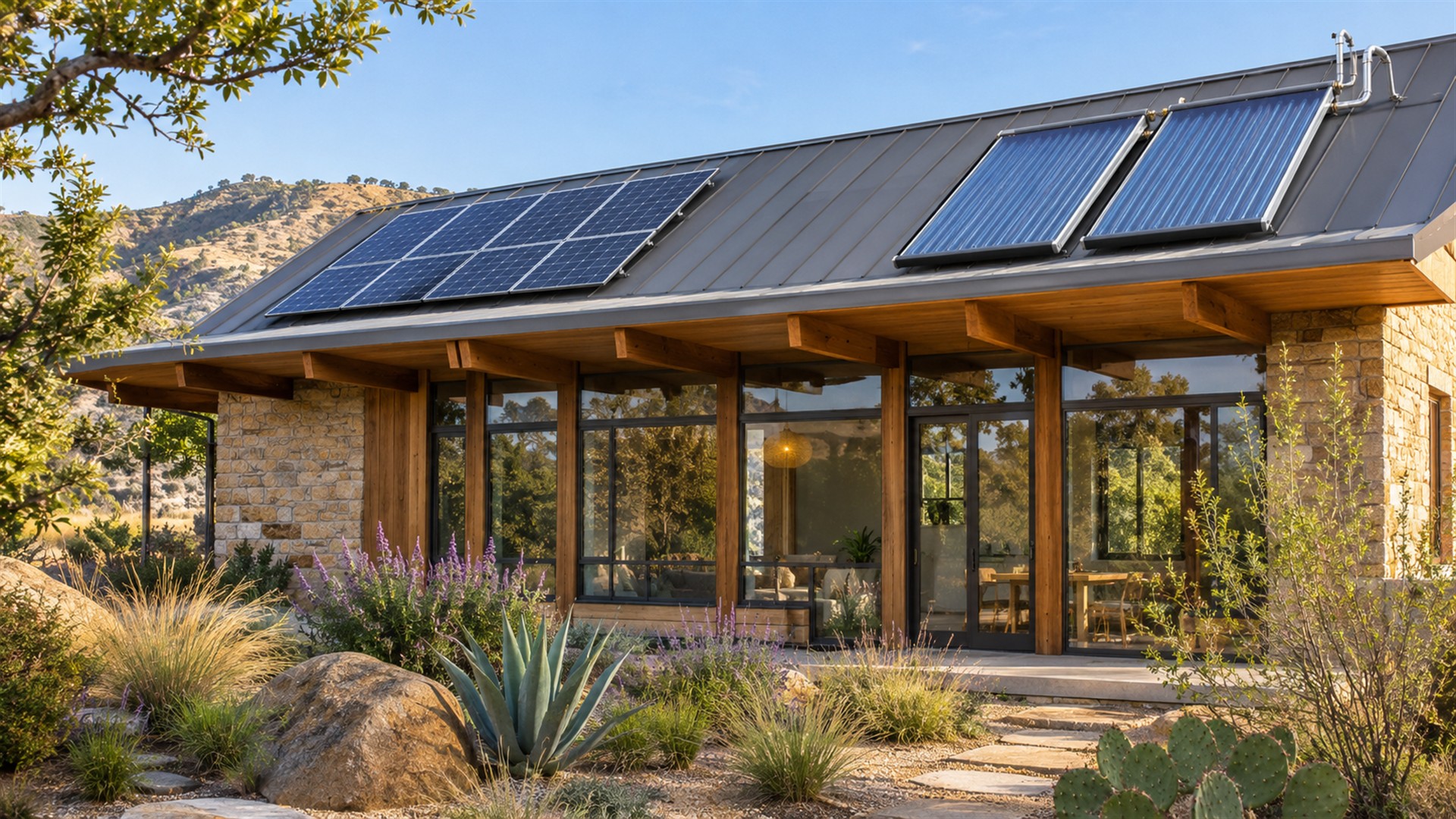
Building-integrated photovoltaics can replace or form part of a roof, facade, or other building element. Solar shingles belong in this discussion because they combine an architectural function with generation. Evaluate them as a building assembly and an electrical system together: weather protection, ventilation, repair access, replacement matching, and the responsibilities of the roofing and solar contractors all matter.
Portable folding panels address a different use case. Transport size, cable connections, compatible input voltage, handling, and real-world setup become central. A module that performs well on a fixed roof may be cumbersome at a campsite, while a convenient folding panel may not be approved for permanent mounting. Suitability follows the intended application, not the shared ability to generate electricity from sunlight.
Glass-glass, glass-backsheet, rigid, and flexible also describe construction choices with tradeoffs. Weight, mounting requirements, environmental protection, and warranty conditions vary by product. Avoid making a universal durability ranking from one construction word. The relevant evidence is the exact module’s documentation, the conditions it is designed to withstand, and the way the installer will support it over the ownership period.
Read Warranty Coverage as Separate Promises
A performance warranty describes an output commitment under stated conditions, while a product warranty addresses specified equipment defects. Neither automatically pays for every diagnostic visit, removal, shipping cost, or reinstall. The installer may provide separate workmanship coverage. Ask who handles each claim and what happens if the original installer stops trading. For less common panel families or unusual formats, the availability of compatible replacements deserves particular attention because physical and electrical matching can affect future repairs.
Choose the Panel That Fits the Finished Project
Start with the site’s constraints and goals. If roof area limits capacity, compare several layouts using the exact proposed dimensions. If space is plentiful, examine whether the premium for greater power density improves output or simply buys unused capability. If appearance is a priority, request a clear visual description alongside the electrical specifications. Different goals can justify different choices without making one technology the universal winner.
Then compare each shortlisted system using a common set of facts: installed capacity, expected annual energy, equipment models, included work, service arrangements, and total cash price. Where a special feature is claimed to increase production, ask how that increase was modeled for the site. A bifacial feature, for example, should have a credible rear-light explanation rather than an automatic percentage bonus in a sales table.
Finally, keep the terminology in proportion. Material families help organize the options, and architecture names help explain product differences, but a good installation is a coordinated system. The best panel choice is one that fits the roof, works with the selected electrical equipment, offers a justified cost, and can be supported after installation. That approach makes marketing labels useful background rather than the deciding evidence.
Make the Equipment Schedule Part of the Agreement
A panel comparison is most useful when its conclusions survive procurement. Ask for the agreed manufacturer, full model designation, quantity, and relevant specification revision in the contract documents. If stock changes, the replacement should be reviewed for dimensions, electrical limits, performance, appearance, and warranty before acceptance. A nominally equal wattage does not establish that every other feature is equivalent, especially on a closely packed roof. Clear substitution terms protect the design work already done and give both homeowner and installer an orderly way to handle supply changes.
At handover, retain the final equipment list with the layout and commissioning information. Check that it describes the installed products rather than an earlier proposal. This record helps a service technician find the right instructions and makes future repairs easier to scope. It also preserves the reasoning behind a technology choice: whether the priority was limited area, visual consistency, portability, or integration with a building assembly. A few accurate documents can be more useful during ownership than a large collection of brochures about panel families.