A Story Written in Sunlight
The history of solar power is, in many ways, the history of human curiosity. Long before modern engineering, silicon cells, and sprawling solar farms, people understood that the sun was more than a bright object in the sky. It was warmth, rhythm, harvest, comfort, and survival. Entire civilizations were shaped around its cycles. Homes were built to catch winter light. Communities planned around daylight hours. Fields, trade routes, and architecture all reflected an intimate knowledge of how sunlight shaped life on Earth. What makes the story of solar power so compelling is that it did not begin with electricity. It began with observation. Human beings noticed that some walls stayed warmer than others, that certain rooms trapped heat more effectively, and that sunlight could be used intentionally rather than passively endured. Over centuries, that practical awareness evolved into scientific investigation. What was once common-sense design slowly became a field of discovery. The complete history of solar power is not a straight line from old to new, but a fascinating arc of ideas, experiments, setbacks, breakthroughs, and reinvention.
A: No. Nighttime power comes from the grid, a battery, or another energy source.
A: Yes, but production is usually lower than it is under strong direct sunlight.
A: Not always. Many systems are grid-tied without batteries, while backup designs need storage or another backup source.
A: Many panels are designed for decades of service, with gradual output loss over time.
A: Sometimes it can reduce energy charges greatly, but fixed fees, seasonal use, and utility rules still matter.
A: Standard grid-tied systems usually shut down unless approved backup equipment is installed.
A: It should be checked carefully because roof replacement after installation can require panel removal and reinstallation.
A: They can help when space is limited, but cost, warranty, layout, and total production matter too.
A: Owners usually watch monitoring, keep panels reasonably clear, and arrange service when output or equipment looks abnormal.
A: Review energy use, roof condition, shade, utility rules, goals, and realistic budget before comparing systems.
Ancient Civilizations and the First Solar Thinking
Thousands of years ago, the earliest forms of solar use were woven into daily life. Ancient builders may not have spoken in the language of renewable energy, but they understood the power of orientation, shade, and heat. In many parts of the world, homes and public buildings were positioned to capture the low winter sun while limiting harsh summer exposure. This was not electricity, of course, but it was solar design in its earliest and most practical form.
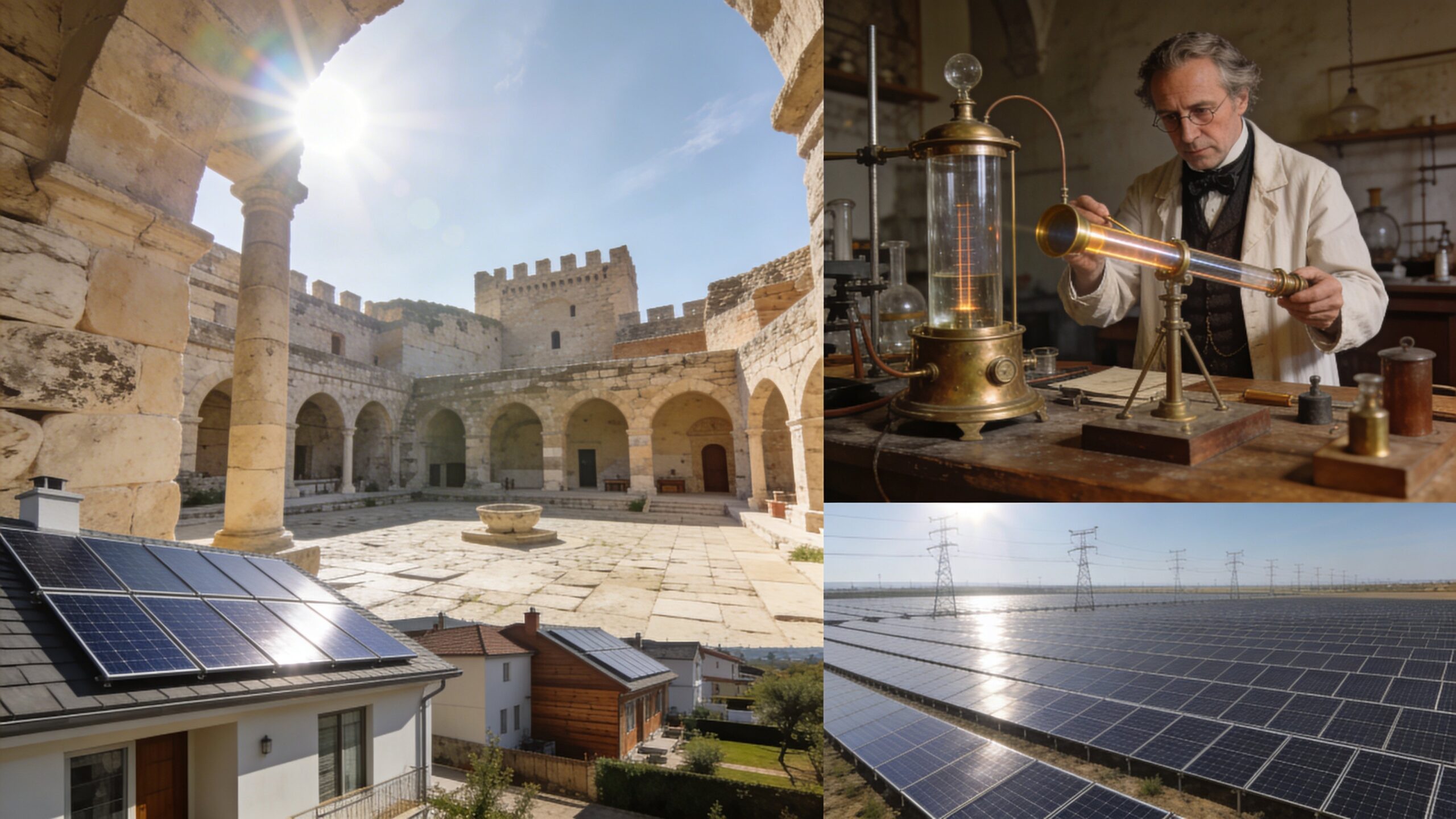
The Greeks and Romans became especially skilled at integrating sunlight into architecture. South-facing windows, thermal mass, and open courtyards allowed buildings to collect and retain warmth. Roman bathhouses and large public structures often demonstrated a sophisticated understanding of how sunlight and heat moved through space. Across other civilizations, from desert settlements to mountain communities, similar principles appeared. The sun was not yet a power source in the modern sense, but it was already being managed as a valuable energy asset.
This early chapter matters because it reveals a truth that still defines solar power today: success begins with understanding how light behaves. Even the most advanced solar systems rely on that same principle. Position matters. Exposure matters. Timing matters. The earliest solar thinkers did not have photovoltaics, but they had something just as important for their moment in history: attentiveness.
Science Turns Sunlight Into a Question
The next great leap came when sunlight moved from the realm of architecture and heat into the realm of scientific experimentation. By the eighteenth and nineteenth centuries, inventors and researchers were becoming increasingly interested in the possibility that sunlight could do more than warm surfaces. Could it be transformed? Could it generate motion, heat, or even electricity in a controlled way?
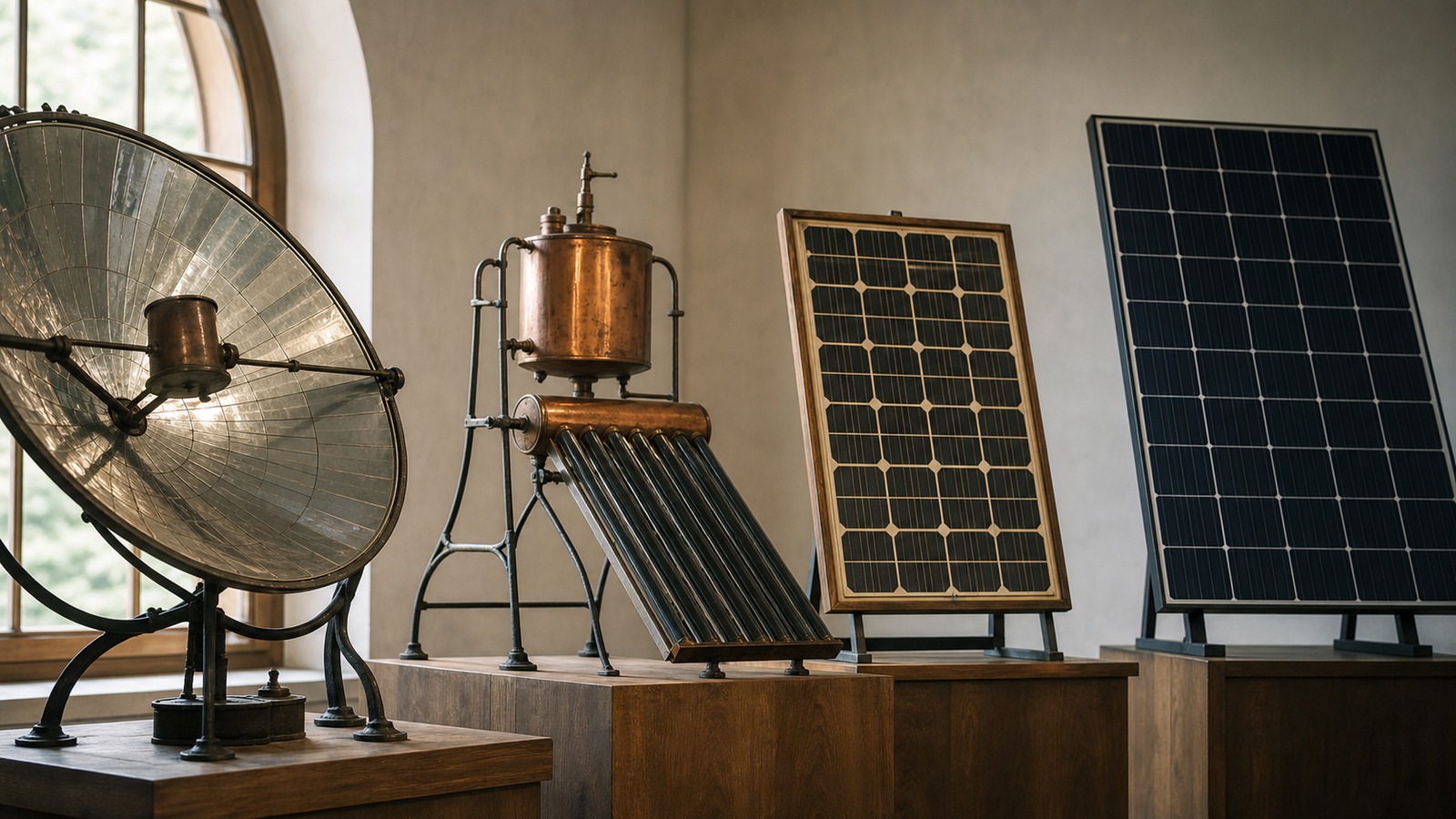
One of the earliest major developments came through experiments in solar thermal power. Inventors used mirrors and lenses to concentrate sunlight, proving that solar heat could be intensified and directed. These efforts were dramatic, sometimes theatrical, but they were also important. They suggested that the sun was not just ambient energy floating all around us. It could be gathered, focused, and made to perform work. The real turning point arrived when scientists began studying how light interacted with certain materials. This line of inquiry led to one of the most important moments in energy history: the discovery that light could help generate electrical current. Suddenly, sunlight was not just a source of warmth or mechanical heating. It was beginning to look like a pathway to electricity itself.
The Discovery of the Photovoltaic Effect
Any complete history of solar power must pause at the discovery of the photovoltaic effect, because this was the breakthrough that changed the future. In the nineteenth century, researchers observed that certain materials produced small electrical currents when exposed to light. At first, the effect was weak and mostly of scientific interest. It did not immediately lead to practical devices, and for many years it remained more curiosity than solution.
Yet the importance of the discovery cannot be overstated. It established the core scientific principle behind modern solar panels. For the first time, the idea of converting sunlight directly into electricity was no longer imagination. It had moved into reality, even if only in small and imperfect ways. Like many transformative discoveries, the photovoltaic effect did not revolutionize society overnight. It lingered in laboratories and technical papers. Researchers continued to test materials, refine theories, and ask whether the effect could be amplified into something useful. That slow, patient period of inquiry would prove essential. Solar power was beginning to acquire a scientific backbone.
The First Solar Devices and Early Limits
As the nineteenth century gave way to the twentieth, inventors began building the first rudimentary solar-powered devices. These systems were often fragile, expensive, and limited in output. They could demonstrate the concept, but they could not yet compete with the energy systems that were already dominating industrial society. Coal, oil, and later widespread electric grids offered scale, convenience, and economic momentum that solar technology simply could not match at the time.
Still, early solar inventions mattered because they transformed theory into hardware. Scientists and engineers were no longer just describing what light could do. They were building instruments that proved it. Solar-powered engines, thermal collectors, and experimental photovoltaic cells all helped push the field forward, even when commercial success remained distant. This period also revealed one of the recurring themes in solar history: the best idea does not always win first. Solar power was clean, elegant, and conceptually powerful, but the world was being built around fossil fuels. Infrastructure, transportation, manufacturing, and politics all leaned heavily toward carbon-based energy. Solar technology would need not only technical improvement but also the right historical moments to rise.
The Silicon Revolution
The modern age of solar power truly accelerated in the mid-twentieth century. This was the era when scientists achieved a breakthrough that changed solar energy from a scientific novelty into a credible power technology: the development of far more effective silicon solar cells. Silicon offered a path toward better efficiency and more reliable performance, and that shift transformed expectations.
For the first time, solar electricity looked practical enough to serve real applications. The cells were still costly, and widespread public adoption remained far away, but the technological leap was undeniable. Solar power was no longer just an interesting experiment. It had become a serious engineering achievement. This breakthrough also helped define the visual identity of solar energy that most people know today. The flat panel, the photovoltaic module, the grid of sunlight-harvesting cells—these features emerged from decades of material science, refinement, and manufacturing innovation. Silicon did not solve every challenge, but it gave solar power a foundation strong enough to build on.
Space Exploration Gives Solar Power a Purpose
One of the most exciting chapters in the history of solar power came from space. Satellites required dependable, long-lasting energy sources, and solar panels turned out to be ideal. In orbit, sunlight was abundant, and solar systems could provide power without the need for constant refueling. This gave solar technology a high-value application at a moment when performance mattered enormously.
Space exploration did more than use solar panels; it gave them prestige and momentum. Government agencies and research institutions invested in the improvement of solar cells because the stakes were high. Reliability, durability, and efficiency became urgent priorities. When solar power proved it could work in space, it gained credibility on Earth. This space-age association also helped reshape public perception. Solar power began to feel futuristic rather than experimental. It became linked with innovation, advanced science, and long-term thinking. In a sense, satellites helped solar energy build a reputation before it built a mass market.
The Energy Crises That Changed the Conversation
The 1970s marked a dramatic turning point. Global energy crises exposed the vulnerabilities of relying so heavily on conventional fuel systems. Prices surged, uncertainty spread, and nations began to reconsider where energy came from and how secure those supplies really were. In that moment of instability, solar power suddenly looked less like a distant possibility and more like a strategic alternative.
Interest in solar research expanded quickly. Governments introduced programs, funding increased, and public curiosity grew. Solar heating systems, rooftop concepts, and renewable energy policy discussions gained new attention. The technology still faced major cost and efficiency challenges, but it now had something equally important: urgency. This period did not instantly make solar mainstream, but it changed the conversation. Solar energy became part of national planning, public debate, and long-term infrastructure thinking. It was no longer confined to scientists and niche enthusiasts. It had entered the broader cultural imagination.
From Expensive Specialty to Growing Industry
In the decades that followed, solar power went through a crucial maturation process. Researchers improved cell efficiency. Manufacturers refined production methods. Installers developed better mounting systems. Engineers improved inverters, controls, and system design. Piece by piece, the solar industry became more practical, more durable, and more scalable. Perhaps the most important shift was economic. As manufacturing expanded and technology improved, costs began to fall. What had once been prohibitively expensive slowly became more accessible. That trend would eventually become one of the biggest drivers of solar adoption worldwide. Lower prices did not mean lower significance. In fact, they meant the opposite. Solar was becoming relevant to everyday users rather than only specialized institutions. This stage also saw the expansion of solar beyond research sites and remote systems. Homes, schools, businesses, and public facilities increasingly viewed solar installations as realistic investments. The technology had crossed a threshold. It was no longer just a symbol of environmental aspiration. It was becoming a working part of real energy systems.
The Rise of Residential and Commercial Solar
As solar panels became more affordable and efficient, rooftops began to change. Residential solar systems gave homeowners a new relationship with electricity. Instead of being only consumers of energy, they could also become producers. That shift was culturally powerful. It made solar visible in neighborhoods, schools, and commercial districts. Renewable energy was no longer distant or abstract. It was suddenly next door.
Commercial adoption accelerated the trend. Warehouses, office buildings, farms, and institutions found that large roof areas and open land could support meaningful solar generation. Pair that with falling equipment costs and supportive policies in many regions, and solar’s growth became increasingly hard to ignore. This phase also helped create a broader ecosystem around solar power. Financing models improved. Installation businesses expanded. Software for monitoring and managing systems became more sophisticated. Battery storage began to play a stronger supporting role. Solar was evolving from a product into a complete energy category.
The Modern Solar Era
Today, solar power stands at the center of the renewable energy conversation. Massive solar farms now feed electricity into national grids. Rooftop systems are common in many regions. Portable solar products power remote work, outdoor travel, and emergency backup systems. Building-integrated solar materials and next-generation cell designs are pushing the technology into new territory. Modern solar systems are more advanced than earlier generations in nearly every way. Panels are more efficient, more durable, and more aesthetically adaptable. Monitoring systems provide real-time performance data. Battery technology is improving how solar energy is stored and used. Research into new materials continues to expand what future solar devices may look like. Most importantly, solar power is no longer defined only by potential. It is defined by deployment. It is already shaping how the world generates electricity, how governments plan infrastructure, and how communities think about resilience and sustainability.
Why the History of Solar Power Still Matters
Looking back at the complete history of solar power reveals more than a sequence of inventions. It reveals a pattern of persistence. Solar power did not emerge through one sudden miracle. It advanced through centuries of insight, decades of refinement, and repeated moments when science, necessity, and opportunity aligned. That history matters today because it helps explain why solar power continues to evolve so rapidly. The breakthroughs of the past were not isolated events. They created the knowledge base, manufacturing systems, and cultural confidence that support current innovation. Ancient builders taught the value of sunlight awareness. Early scientists revealed the physics. Space exploration proved durability. Energy crises created urgency. Modern engineering delivered scale.
Solar power’s journey from ancient times to today is ultimately a story about learning to see the sun differently. What was once simply part of the background of life has become one of the most promising pillars of the global energy future. And if history is any guide, the next chapter in solar power will not just be brighter. It will be smarter, broader, and more integrated into everyday life than ever before.