Look for the Physical Change Behind the Benefit
When a home begins producing solar electricity, the important environmental change is not the appearance of panels on the roof. It is that some electricity can be supplied without burning fuel at the point of generation. Depending on the wider power system, that can reduce emissions and other burdens associated with producing electricity elsewhere. The benefits are meaningful, but they are neither identical at every location nor a reason to ignore the materials and work required to build the solar system. A useful explanation follows the change from sunlight to usable electricity, then asks which activities are reduced, which impacts remain, and what choices improve the outcome. This keeps environmental claims connected to real energy services rather than treating a solar installation as proof that every part of household life has become sustainable.
A: It adds generation without fuel combustion at the module, potentially reducing other generation.
A: Equipment life-cycle impacts and remaining electricity supply still require consideration.
A: It can use an existing built surface rather than develop a separate site.
A: It depends partly on the generation and cooling processes being displaced.
A: A household-wide claim needs a broader account than rooftop electricity alone.
A: Storage adds equipment and losses, so its operating benefit needs evaluation.
A: Restoring production can preserve useful service from equipment already manufactured.
A: No. Collection, processing access, costs, and responsibility still matter.
A: Evaluate its broader value and the site's alternatives before deciding.
A: Identify the affected activity, comparison basis, relevant period, and uncertainty.
Generating Electricity Without On-Site Combustion
Photovoltaic modules convert light into electrical current without a fuel-burning engine or boiler in the module. During ordinary generation, there is no chimney releasing combustion exhaust from that process. This is a direct operational distinction from a fossil-fueled generator. It does not imply that making, transporting, installing, or retiring the equipment has no emissions. Those activities belong in the broader environmental account.
The displaced electricity matters. A solar kilowatt-hour may reduce the need for generation elsewhere, but the affected generator depends on the region, hour, dispatch conditions, and wider grid. The environmental value should therefore be described with an appropriate comparison. A homeowner can reasonably seek lower-impact electricity while recognizing that the precise avoided burden requires more information than the panel count or annual household bill.
Life-Cycle Evidence Shows the Scale of the Climate Difference
A primary comparison gives the benefit more meaning than the phrase low carbon alone. NREL’s September 2021 fact sheet, Life Cycle Greenhouse Gas Emissions from Electricity Generation: Update, reports literature-compilation medians of 43 grams of carbon-dioxide equivalent per kilowatt-hour for photovoltaics, 486 for natural gas and 1,001 for coal. These include life-cycle stages, not just exhaust at the generating site. The PV median is roughly one-eleventh of the gas value and one-twenty-third of the coal value in that compilation.
Those historical study medians establish a substantial contrast without determining the exact benefit of a new roof. They combine assessed technologies and conditions rather than model the generator displaced by your particular midday export. They also do not price habitat, water or every local effect in one carbon number. The result supports a climate advantage over fuel-burning generation, while the actual avoided-emissions claim still needs an appropriate local and temporal comparison.
Manufacturing changes can improve the equipment side of the account. IEA PVPS published a new life-cycle inventory in July 2026 covering updated silicon and CdTe supply chains and reference systems. An inventory supplies the inputs for assessments; its publication alone is not a new universal emissions rate. For your project, useful production over a credible operating life remains important because it spreads upfront equipment burdens over the electricity actually delivered.
Air-Quality Effects Extend Beyond Carbon
Combustion can release air pollutants as well as greenhouse gases, although the pollutant mix and controls vary by generator. When solar reduces generation from affected fuel-burning plants, it can also reduce some associated air-pollution burdens. The local and regional consequences depend on where the displaced generation operates and how emissions are transported. Avoid assigning a guaranteed neighborhood health outcome to one rooftop project without evidence connecting those steps. The defensible benefit is the potential reduction in relevant upstream combustion activity, evaluated in the actual power-system context.
Water Use Depends on the Generation Pathway
Electricity technologies differ in their water needs, especially where thermal power plants use water for cooling. Ordinary photovoltaic generation does not require that same steam-cycle cooling process. Replacing some water-intensive electricity supply can therefore reduce associated water demand. The size of the benefit depends on the displaced generation, its cooling configuration, the region, and the time period being assessed rather than on a single national assumption.
PV is not water-free across its life cycle. Manufacturing processes can use water, and some installations need occasional cleaning. Cleaning requirements vary with climate, dirt, access, and manufacturer guidance. A household should not waste water or take rooftop risks simply to support an environmental narrative. The useful objective is a sound installation with an appropriate maintenance plan, assessed against the alternatives that would otherwise provide the same electricity.
Existing Roofs Can Limit Additional Land Conversion
Putting panels on a suitable existing building uses a surface already devoted to a built structure. That can avoid some of the additional land disturbance associated with developing a new standalone site. The benefit is especially clear as a siting distinction, although the roof still needs appropriate structural, weatherproofing, access, and electrical design. Using existing space well should not be confused with permission to ignore the condition of the building that supports the equipment.
Large ground-mounted projects introduce a different set of choices. Vegetation, habitat, soil, drainage, roads, fencing, and land management can influence their environmental consequences. Some projects can coordinate electricity generation with other land uses, but the success of those arrangements is site-specific. A photograph of vegetation beneath panels does not establish a net biodiversity benefit. The relevant evidence includes the site’s prior condition and the management plan over time.
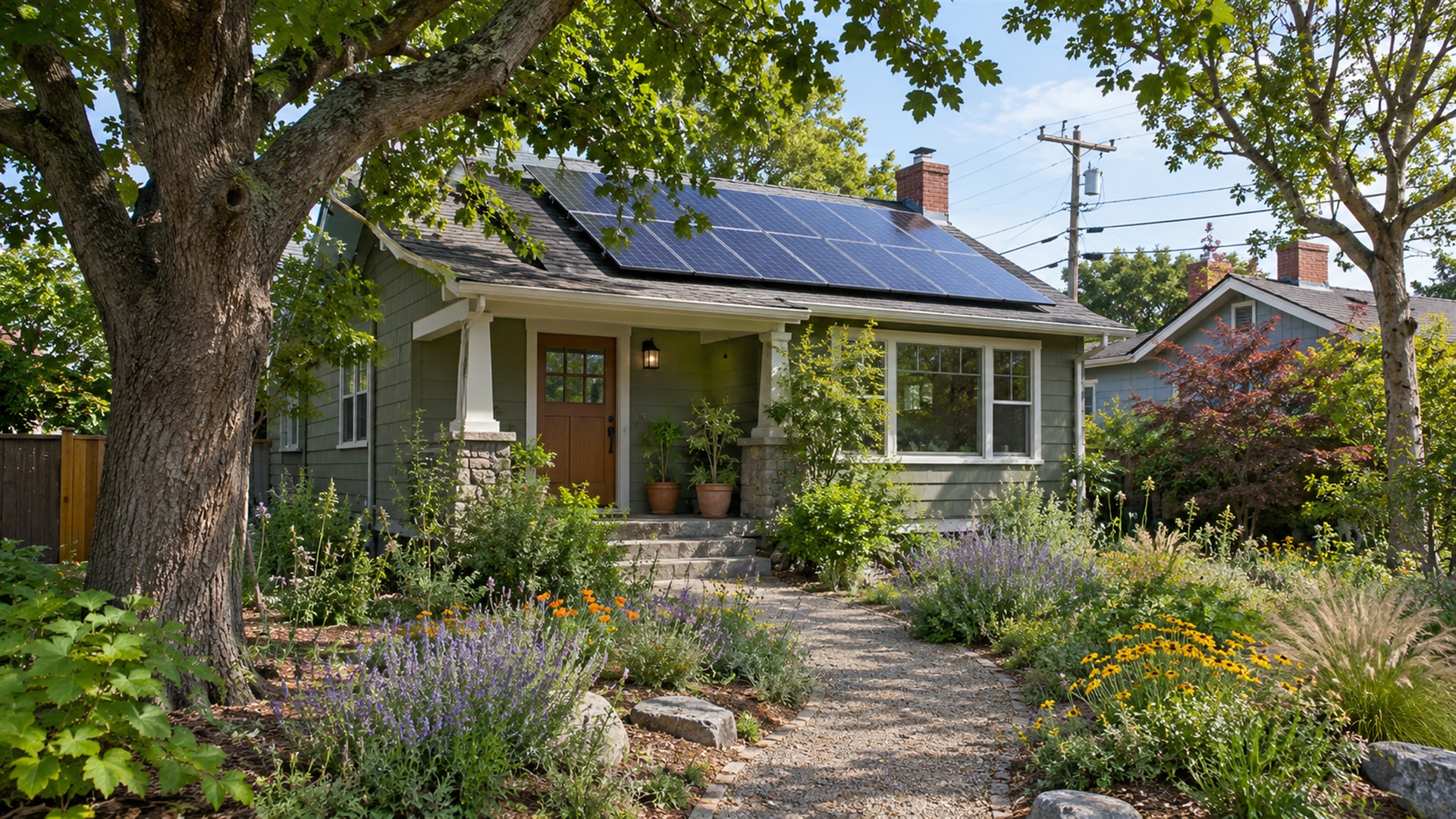
For homeowners, practical siting can include retaining valuable trees where possible, choosing an appropriate roof plane, and avoiding unnecessary disturbance around ground equipment. There can be real tradeoffs between shade, habitat, cooling, and production. Discuss them explicitly rather than assuming that maximizing panel exposure overrides every other environmental consideration on the property. The best project addresses the building and landscape as a connected place.
Using Solar Electricity Well Can Reduce Purchased Energy
On-site solar can supply part of a home’s electrical demand, while surplus production may be exported under the utility’s arrangements. Electricity used in the home and electricity sent to the grid follow different commercial accounting paths, but both may contribute to the wider energy system. The environmental interpretation depends on the generation displaced and the timing. An annual matching claim does not mean the household operates independently of the grid every hour.
Demand reduction remains useful alongside generation. Efficient appliances, appropriate controls, and a better-performing building can reduce the energy service that must be supplied in the first place. Solar then serves a smaller or more manageable load. This is a practical complement rather than a competition between conservation and renewable electricity. A household can improve both sides while recognizing that the value of each measure depends on the existing equipment and use pattern.
Electrification Needs a Complete Energy-Service Comparison
Solar electricity may support a change from fuel-burning household equipment to electrical alternatives, but the result depends on the replacement appliance and how it is used. A heat-pump system, for example, should be assessed through the useful heating service it delivers and its operating conditions. The mere presence of panels does not establish that every electrical substitution lowers environmental burdens. Compare the full service, the source of electricity, and the equipment’s performance with appropriate technical guidance.
Storage Adds Flexibility and Additional Equipment
A battery can shift electricity from a time of generation to a later period. That may support household operation, backup objectives, or grid needs depending on the design. It also introduces manufacturing impacts, energy losses, controls, and eventual replacement or retirement. An environmental case for storage therefore needs a defined operating purpose rather than assuming that adding more hardware automatically makes a solar project greener.
Timing affects the result. Charging and discharging can change which generation is displaced, while losses mean that delivered energy is lower than the energy used to charge. A useful evaluation compares the system with and without storage under realistic operating conditions. Household resilience can still be a legitimate reason to buy a battery even where the emissions benefit is uncertain. Keeping those purposes separate leads to clearer decisions.
Equipment Longevity Helps Preserve the Original Investment
Reliable operation allows materials and installation work to support useful energy production over a longer period. That gives maintenance, accessible equipment, and clear service responsibility a role in environmental performance. An installation with poor connections, avoidable damage, or no workable repair route can lose useful production before the modules reach the end of their technical potential. Product selection and workmanship therefore belong in the environmental discussion alongside rated efficiency.
Replacing functioning equipment solely for a newer label deserves careful review. The new system might offer a genuine capacity, safety, or service benefit, but it also requires additional products and work. Compare the existing equipment’s condition and output with the complete replacement project. A measured improvement is stronger evidence than an assumption that newer always means environmentally preferable regardless of what is removed.
Keep records that support future maintenance and reuse decisions. Model identification, the final layout, commissioning results, and service history help qualified people understand the installation. Clear records can make a modest repair possible when uncertainty would otherwise encourage replacement. Their environmental value is indirect but practical: they help preserve useful service from equipment that has already been manufactured.
Retirement Planning Keeps Benefits From Becoming a Disposal Claim
Solar modules contain materials that can potentially be recovered, but recovery depends on available collection, processing, economics, and applicable rules. Recyclability is not proof that a particular retired module will actually enter a suitable recycling route. Ask how damaged or end-of-life equipment will be handled and what costs or responsibilities remain with the owner. Useful environmental planning follows the product beyond its last generating day instead of ending at the installation photograph.
Reuse can also require careful assessment. A module suitable for continued service needs appropriate condition evidence and an application that matches its electrical and physical characteristics. Passing unwanted equipment to an unknown buyer is not enough to establish an environmental benefit. The useful objective is legitimate continued service or responsible material handling, with the relevant documentation and professional judgment where needed.
Describe the Household Change Honestly
State what the project does in concrete terms: it adds a defined capacity, is expected to generate a stated range of electricity, and may reduce specified upstream burdens under stated assumptions. Keep claims about climate, air quality, water, and land separate because they arise through different mechanisms. A reduction in one category does not prove that all others improve by the same proportion.
Also distinguish electricity from the household’s entire footprint. Transport, food, heating fuels, purchases, and building materials remain relevant, and some may change independently of solar. A rooftop array can be a meaningful contribution without supporting a claim of complete environmental neutrality. That honest boundary makes the benefit more credible and gives the household a clearer view of other useful improvements.
Going solar changes an energy supply pathway and creates an opportunity to manage it well. The strongest environmental outcome comes from appropriate siting, dependable production, sensible demand choices, useful equipment life, and responsible retirement. Evaluate those physical changes with evidence and realistic assumptions. Solar’s value is easier to understand when it is explained through the work it does and the burdens it can reduce, rather than through a label that asks one installation to stand for every aspect of sustainability.
Retain the Evidence Behind the Project
Keep environmental calculations with their sources and original assumptions. A later equipment change, revised production estimate, or different electricity comparison can alter the result. Updating the claim is easier when its basis remains available. Good records help the household describe its contribution accurately rather than repeating an old number whose meaning has been lost.