Solar Has a Life-Cycle Footprint and a Strong Climate Case
Solar panels are not impact-free, yet primary life-cycle research supports a substantially lower climate burden than electricity generated by burning fossil fuels. That conclusion includes making and supporting the equipment; it does not depend on pretending manufacturing disappears. A published residential reference assessment offers a concrete starting point: IEA PVPS reports 35.8 grams of carbon-dioxide equivalent per delivered kilowatt-hour for its modeled monocrystalline system. That is a result for a defined system, resource and life, rather than a footprint stamped on every panel. Following the assessment from materials to retirement explains both why solar can be environmentally preferable and which conditions could weaken the outcome. Climate, resource use and local land effects still need their own evidence.
A: It is part of the equipment needed to deliver useful electricity from the system.
A: Only after the service period, output, and boundaries are made consistent.
A: With the same burden allocated over less electricity, the per-unit result rises.
A: No. Hypothetical inputs illustrate arithmetic and must remain clearly identified.
A: Product processes, energy inputs, output, lifetime, and other stages also matter.
A: Check first whether that result already includes recovery and substitution benefits.
A: They measure different relationships and depend on different assumptions.
A: No. Site-specific land and ecological effects may require separate review.
A: They can help assess condition, legitimate reuse, and appropriate handling routes.
A: Check its service unit, boundary, technology, data year, lifetime, and production assumptions.
Start With a Published Residential Assessment
IEA PVPS’s Environmental Life Cycle Assessment of Electricity from PV Systems, published in May 2024 with its 2023 data update, models a 3-kilowatt rooftop system and reports 35.8 grams of carbon-dioxide equivalent per kilowatt-hour AC for monocrystalline silicon. Its European reference yield is 976 kilowatt-hours per installed kilowatt annually, including the specified degradation treatment. The calculation assumes a 30-year panel life and a 15-year inverter life. It is an attributed modeled result, not a measurement from a reader’s roof or a claim that all 2026 products share that footprint.
The same assessment places nonrenewable energy payback at 1.0 year for its mono-silicon reference. That compares the nonrenewable primary energy invested with the electricity service under the study’s method; it is not household financial payback. Together the findings show why equipment manufacture can be repaid in energy terms while leaving a nonzero life-cycle footprint. Use the rest of the method to judge how well the reference fits another project, rather than replacing every roof’s evidence with its numbers.
Set the System Boundary Before Adding Numbers
A module-only assessment can omit racking, inverters, wiring, foundations, installation, maintenance, and retirement. A complete-system study may include those elements, but its exact scope still needs checking. Batteries introduce another set of equipment and operating effects if they are present. Read what the study includes before treating its result as a footprint for a finished household installation. A concise boundary statement often reveals more than a precise headline number without context.
Manufacturing Creates Real Upfront Burdens
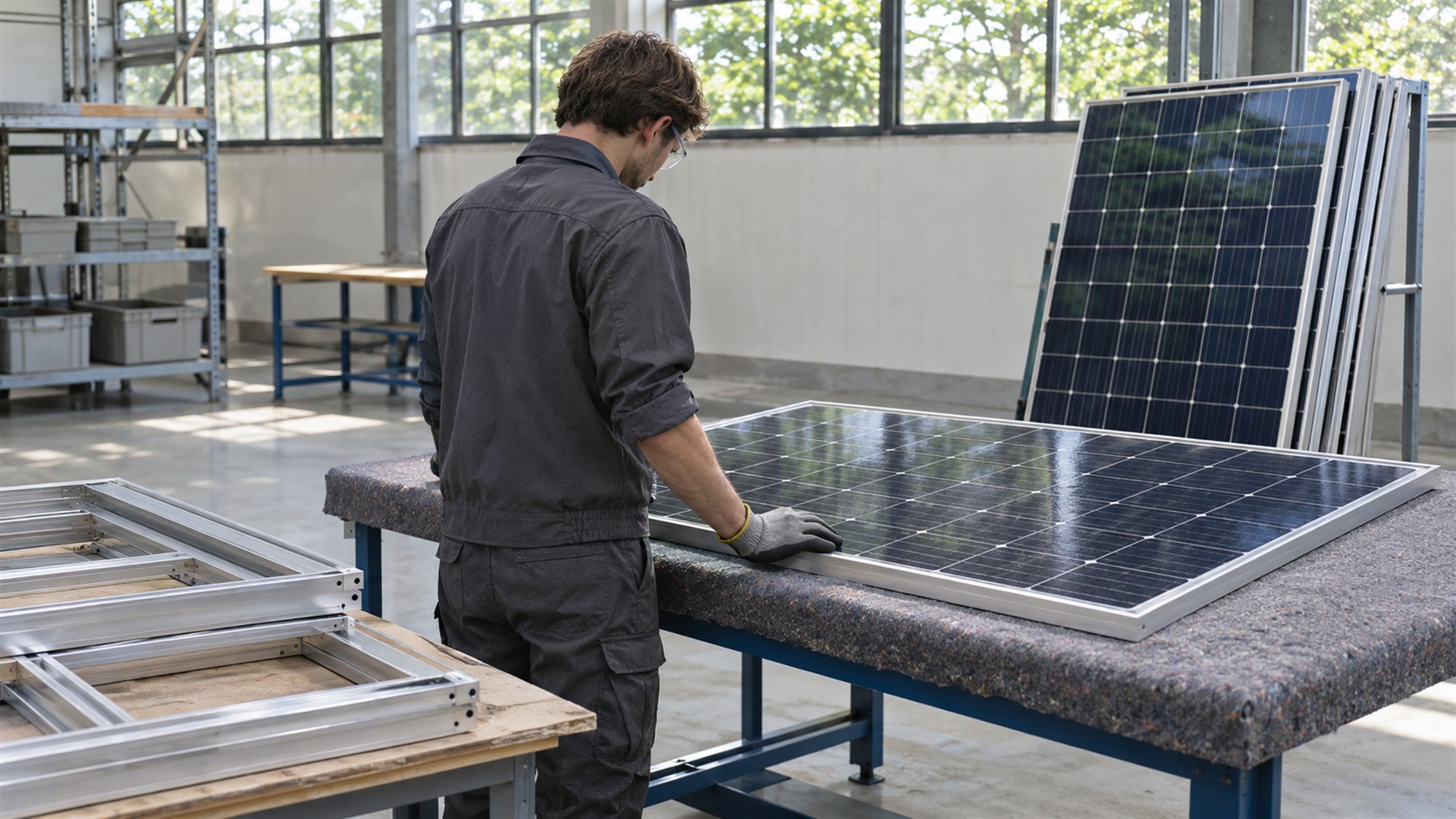
Producing PV equipment requires materials and energy. Silicon processing, glass, aluminum, metals, polymers, and manufacturing operations contribute in ways that depend on the product and supply chain. Different module families and designs use different processes and quantities. A life-cycle account therefore needs data appropriate to the equipment being assessed rather than a single timeless footprint assigned to every object called a solar panel.
The electricity and fuels used in manufacturing can influence the result. So can material sourcing, process yields, and the handling of production scrap. An improvement in module efficiency may change the electricity delivered per unit of manufactured area, while changes in production processes can affect the burdens per module. These relationships explain why manufacturing location and year can matter without justifying broad assumptions about every product from a country or brand.
IEA PVPS’s 2026 life-cycle inventory update provides datasets for several current technologies and reference system configurations. Its role is to make the underlying activity and material information available for assessment. The existence of an updated inventory also illustrates why readers should inspect the date and technology basis of an environmental claim. A study remains useful when its assumptions are relevant and clearly understood.
Transport and Installation Belong in the Account
Equipment moves between suppliers, factories, distribution points, and project sites. Transport modes, distances, loads, packaging, and installation activities can contribute environmental burdens. Their importance varies by study and project, so avoid declaring them negligible or dominant without evidence. A local installer does not necessarily imply a local manufacturing supply chain, while an imported module’s shipping distance alone cannot establish its complete life-cycle performance.
Installation adds physical components and work. A rooftop system and a ground mount may use different supports, foundations, access arrangements, and site preparation. A project requiring substantial additional construction should be assessed accordingly. For homeowners, the practical lesson is to examine the complete installed arrangement. The environmental footprint of the module itself cannot describe every consequence of the design chosen to hold and connect it.
Lifetime Generation Changes the Denominator
Once installed, the system produces electricity through changing sunlight, temperature, weather, and equipment condition. Total generation across the assessed lifetime determines how upfront burdens are spread over useful output. A productive installation that operates longer can allocate those burdens across more electricity than an otherwise similar installation that underperforms or is retired early. The assumed service life and production model therefore deserve close attention.
Consider a purely illustrative footprint of 1,000 kilograms of carbon-dioxide equivalent allocated over 25,000 kilowatt-hours. The arithmetic gives 40 grams per kilowatt-hour. If useful lifetime generation were only 20,000 kilowatt-hours with the same assumed burden, the result would become 50 grams per kilowatt-hour. These are invented teaching inputs, not a measured footprint for any product. They demonstrate why the output assumption matters alongside the equipment total.
Production should reflect the actual site and reasonable changes over time. Shade, outages, equipment degradation, and replacements can influence the account. A claim based on ideal exposure and uninterrupted operation should not be transferred automatically to a shaded roof with unresolved service problems. The right response is to improve the design or state uncertainty, not simply choose the most favorable lifetime number.
Operation Has Low Combustion Emissions but Is Not the Whole Life Cycle
Ordinary photovoltaic generation does not burn a fuel at the module to make electricity. That operational feature is central to solar’s environmental appeal. However, an assessment that stops at the roof during generation leaves out the burdens already incurred upstream and those expected later. Conversely, an account that counts manufacturing but ignores the delivered electricity omits the service that justifies the equipment. A balanced comparison follows both sides through a consistent period.
Maintenance and Replacements Can Change the Result
Inverters, controls, and other components may require service or replacement during the assessed system life. The chosen replacement assumptions affect the environmental total and the electricity successfully delivered. A study should describe whether it includes those events and how often they are assumed. A long module warranty does not establish that every other component will operate without replacement for the same period.
Maintenance can also preserve useful generation. Promptly diagnosing a fault or addressing a suitable service need may restore output from equipment already manufactured. The environmental effect depends on the work and result, but the general ownership principle is practical: keep the installation serviceable and supported. Clear records, accessible components, and a known repair route help prevent an otherwise useful system from remaining idle because a modest problem becomes difficult to resolve.
End-of-Life Scenarios Need Evidence
A life-cycle model may assume landfill, recycling, reuse, or a mixture of routes. Actual outcomes depend on collection, processing access, applicable rules, economics, and product condition. A module containing recoverable materials does not guarantee that all those materials will be recovered at high quality. Read the assumed treatment and recovery yields rather than treating the word recyclable as a complete retirement plan.
Some models assign benefits for recovered materials that replace future production. Those credits depend on allocation rules and assumptions about what is displaced. Different accounting methods can produce different results from similar physical recovery activities. That does not make the analysis useless; it means the method should be stated so readers can compare studies appropriately. Avoid adding a separate recycling benefit to a published footprint if that footprint already includes it.
Reuse introduces similar care. Continued service can be beneficial when equipment is sound and suited to its next application, but transport, testing, installation, and remaining performance matter. A donation or resale is not automatically proof of useful life extension. Qualified assessment and clear documentation help distinguish legitimate reuse from moving an unresolved disposal problem to someone else.
Climate Is Only One Environmental Impact Category
Life-cycle studies may examine greenhouse gases, water use, resource demand, toxicity-related indicators, and other categories. A favorable climate result does not establish that every impact is equally low or that no local environmental issue exists. The categories describe different mechanisms and can involve tradeoffs. Keep them visible rather than converting an analysis into a broad claim that a technology is impact-free.
Likewise, project siting can involve issues that a generalized product footprint does not fully represent. Habitat, land disturbance, drainage, visual context, and local community effects may require site-specific review. A national per-kilowatt-hour number is not a substitute for that work. The full decision can combine life-cycle evidence with appropriate local assessment instead of asking either one to answer every environmental concern.
Compare Alternatives Using Consistent Methods
To judge whether solar is environmentally preferable, define what would otherwise supply the electricity and evaluate both options on an appropriate basis. A fossil generator has fuel extraction, transport, combustion, and equipment burdens; another low-carbon source has its own infrastructure and operating account. Comparing only selected favorable stages from one option with a complete life cycle from another produces a biased result.
System context can matter when generation timing differs. The consequences of adding variable solar depend partly on the wider electricity system and how demand is served when sunlight is limited. A product life-cycle footprint and an estimate of the changes caused by adding solar to a particular grid are related but different analyses. Identify which question a study answers before using its result to claim a precise real-world emissions reduction.
This distinction is especially useful when a sales presentation mixes a generic solar footprint with a local avoided-emissions claim. Ask where each number comes from, which year it describes, and whether their boundaries are compatible. A calculation can be arithmetically correct while comparing quantities that belong to different accounting frameworks. Transparency makes those limitations easier to recognize and correct.
Read Environmental Payback Claims Carefully
Energy payback and greenhouse-gas payback measure different things. One relates energy invested to energy delivered, while the other compares an emissions burden with an avoided-emissions rate under stated assumptions. Neither automatically describes financial payback. A useful claim identifies the metric, the system boundary, the location, and the production basis. Treat a payback period without those details as incomplete evidence rather than as a universal promise attached to a panel.
Turn the Assessment Into Better Project Choices
For a household, life-cycle thinking supports several practical priorities: choose a suitable site, obtain a realistic production estimate, select supported equipment, protect the building, and plan for service. These choices influence whether the installation delivers useful electricity for the period expected. They also make the project easier to maintain and assess later. A sophisticated environmental number is less useful when the basic system cannot operate reliably.
At retirement, seek a legitimate route appropriate to condition and local requirements. Preserve identification and service records that can help assess reuse or processing options. Ask who arranges removal and what costs are included in any contractor’s offer. The objective is a complete and workable ownership pathway, not a promise that future recycling will erase every burden from the original purchase.
Solar panels can provide substantial environmental value while still requiring responsible material use and management. A life-cycle view strengthens that conclusion by showing what is counted, what service is delivered, and which assumptions affect the comparison. Follow the equipment from raw materials through useful operation and final handling. That is a more durable basis for confidence than either ignoring manufacturing or treating manufacturing alone as the entire environmental story.