Why Solar Panel Types Matter
Solar energy may look simple from a distance. Panels sit on rooftops, fields, carports, and buildings, quietly turning sunlight into electricity. But the technology behind those panels is more varied than many beginners realize. Not all solar panels are built from the same materials, and not all of them perform the same way in the real world. Some are designed to squeeze more power from limited space, while others focus on lower manufacturing cost, flexibility, or future efficiency breakthroughs. The U.S. Department of Energy notes that solar panels are built from semiconductor materials that convert sunlight into electricity, but the specific material and structure of those cells strongly shape how a panel behaves. That is why understanding the main types of solar panels matters so much. If you only hear terms like monocrystalline, polycrystalline, thin-film, or perovskite without context, solar technology can feel like a blur of jargon. In reality, each category tells a story about efficiency, cost, durability, manufacturing, and where that panel type makes the most sense. Once you understand the core differences, the solar world becomes easier to navigate.
A: No. Nighttime power comes from the grid, a battery, or another energy source.
A: Yes, but production is usually lower than it is under strong direct sunlight.
A: Not always. Many systems are grid-tied without batteries, while backup designs need storage or another backup source.
A: Many panels are designed for decades of service, with gradual output loss over time.
A: Sometimes it can reduce energy charges greatly, but fixed fees, seasonal use, and utility rules still matter.
A: Standard grid-tied systems usually shut down unless approved backup equipment is installed.
A: It should be checked carefully because roof replacement after installation can require panel removal and reinstallation.
A: They can help when space is limited, but cost, warranty, layout, and total production matter too.
A: Owners usually watch monitoring, keep panels reasonably clear, and arrange service when output or equipment looks abnormal.
A: Review energy use, roof condition, shade, utility rules, goals, and realistic budget before comparing systems.
The Big Picture: How Solar Panels Work
At the heart of every solar panel is a photovoltaic cell. When sunlight hits a photovoltaic material, part of that light is absorbed, energizing electrons inside the semiconductor. Those electrons begin to move, producing direct current electricity. That electricity can then be routed through wiring and converted by an inverter into alternating current power for homes, businesses, and the grid. The Department of Energy explains that this basic principle applies across solar technologies, even when the materials and construction methods vary.
The differences appear in how well each material absorbs light, how easily electrons move through it, how expensive it is to produce, and how stable it remains over time. Some solar panels rely on thick silicon wafers cut from crystal structures. Others coat very thin layers of photovoltaic material onto glass, metal, or flexible surfaces. Emerging technologies push the idea even further, using materials like perovskites to create cells that may one day combine high efficiency with lower-cost manufacturing.
Silicon Solar Panels: The Foundation of Modern Solar
Silicon is still the backbone of the modern solar industry. The Department of Energy says about 95% of solar panels on the market use monocrystalline or polycrystalline silicon as the semiconductor material, and crystalline silicon remains the dominant commercial platform worldwide. That dominance is not accidental. Silicon offers a strong mix of proven durability, scalable manufacturing, and solid efficiency, which is why it has anchored the industry for decades. Silicon panels are the type most people picture when they imagine rooftop solar. They are familiar, bankable, and widely available. But even within the silicon family, there are important differences. The two best-known categories are monocrystalline and polycrystalline, and each one reflects a different manufacturing approach and performance profile.
Monocrystalline Solar Panels
Monocrystalline solar panels are made from single-crystal silicon. That more uniform crystal structure allows electrons to move more freely, which improves energy conversion efficiency. The Department of Energy says monocrystalline silicon cells can exceed 27% efficiency in ideal laboratory conditions, while industrially produced monocrystalline modules commonly achieve real-world efficiencies around 20% to 22%. That helps explain why monocrystalline panels are often treated as the premium standard in mainstream solar.
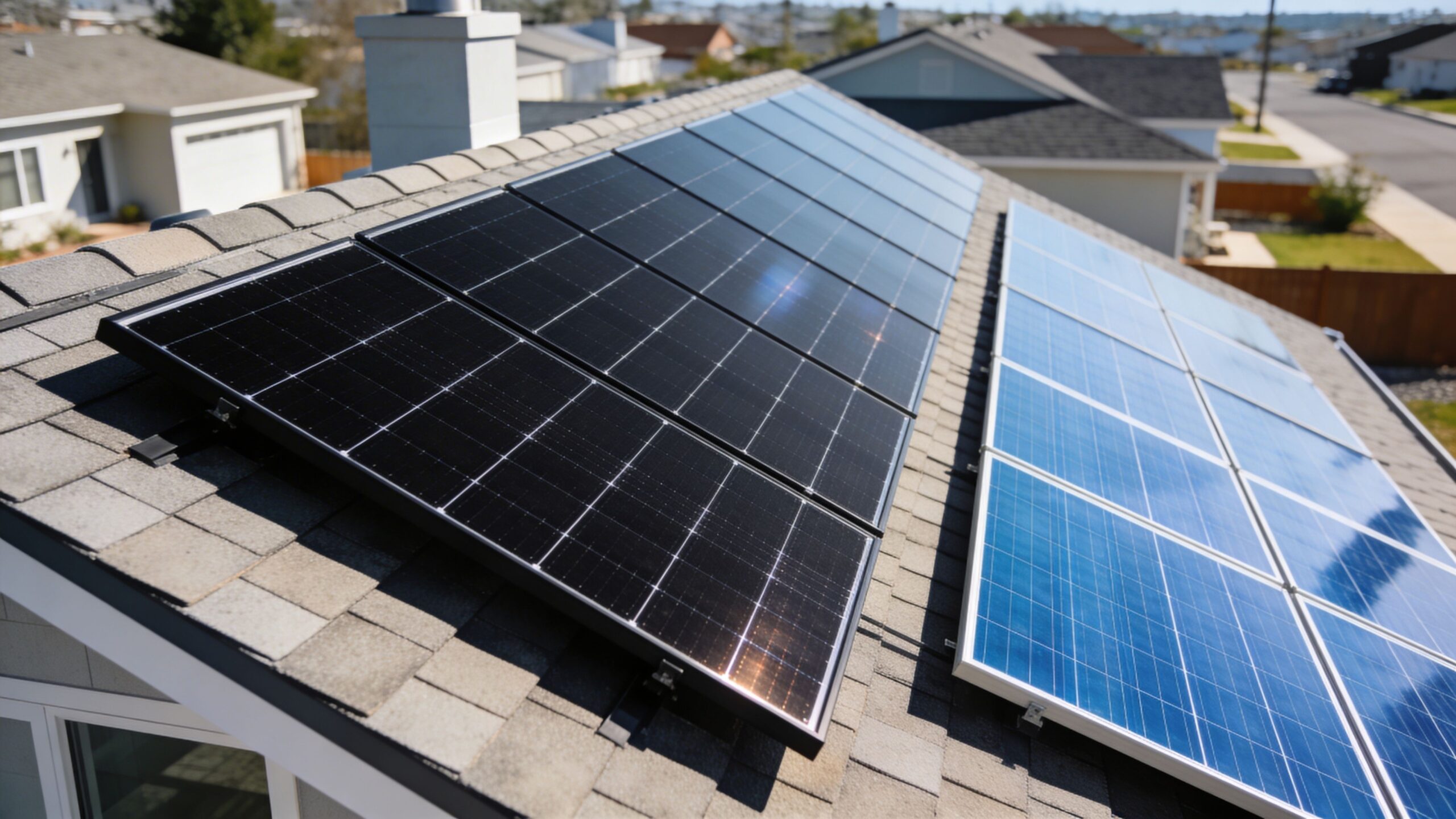
In everyday use, monocrystalline panels are especially attractive when space is limited. Small roofs, complex rooflines, and high-visibility residential projects often benefit from their strong power density and darker, more uniform appearance. They usually cost more than simpler silicon alternatives, but the added efficiency often makes sense when buyers want maximum output from a limited footprint. That is a major reason monocrystalline silicon represented 96% of global solar shipments in 2022, according to DOE.
Polycrystalline Solar Panels
Polycrystalline solar panels are also made from silicon, but instead of a single crystal structure, the cells contain multiple crystal fragments. DOE explains that this difference affects electron movement, which is why polycrystalline panels are generally less efficient than monocrystalline panels. However, they are also less expensive to manufacture, which historically made them appealing for cost-focused buyers. These panels are often recognized by their blue, speckled appearance. They remain a practical choice in projects where installation space is plentiful and reducing upfront cost matters more than achieving the highest efficiency possible. On a large roof or ground-mounted system, the efficiency gap may be manageable if lower panel cost improves the overall economics. They are not the headline technology they once were, but they still illustrate an important truth in solar: the best panel is not always the fanciest one, but the one that fits the site and the budget.
Thin-Film Solar Panels
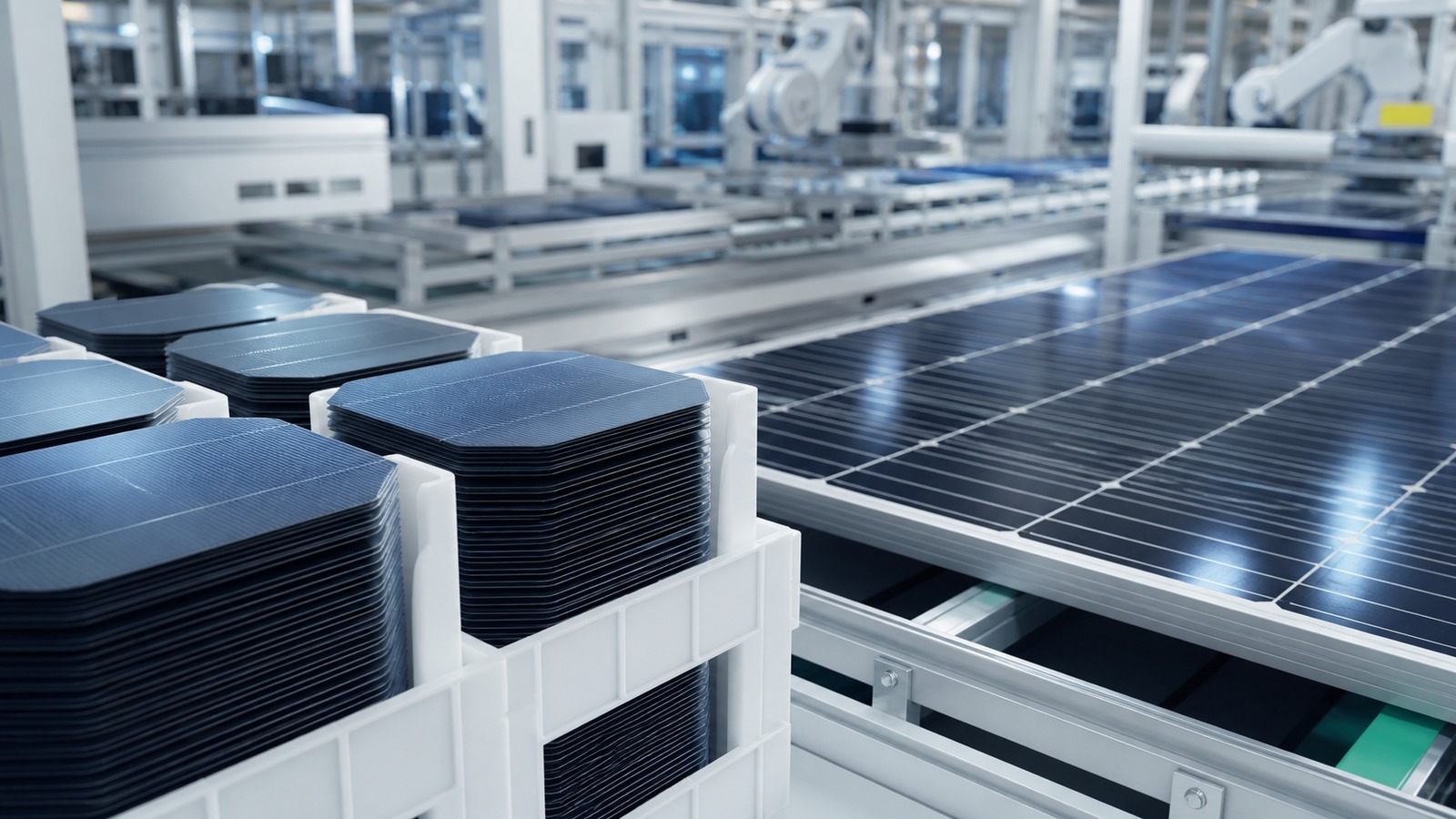
Thin-film solar panels take a different approach. Instead of slicing silicon into wafers, manufacturers deposit very thin layers of photovoltaic material onto a supporting surface such as glass, plastic, or metal foil. DOE describes thin-film cells as being made by coating highly absorptive semiconductor layers onto a substrate, and notes that this can keep costs down while allowing the cells to be more versatile.
This structure gives thin-film technology some unique strengths. Thin-film panels can be lighter than conventional crystalline panels, and some can be flexible or partially transparent. That makes them useful for building-integrated photovoltaics, large-scale solar fields, specialty structures, and portable applications where traditional rigid panels may not be the best fit. Thin films often look more visually uniform than crystalline modules as well, which can matter in architectural design.
Main Thin-Film Materials
Thin-film is not a single material. It is a broader category that includes several photovoltaic chemistries. One important type is cadmium telluride, which has been a major thin-film technology in utility-scale solar. DOE notes that outside monocrystalline silicon, much of the remaining global shipment share has consisted mostly of cadmium telluride. Another thin-film family is CIGS, or copper indium gallium selenide, which is known for versatility and the possibility of flexible applications. Amorphous silicon also fits within the thin-film family, though it usually operates at lower efficiency. Thin-film panels generally do not win the mainstream rooftop market on efficiency, but that is not the whole point of the technology. Their value comes from different strengths, including lighter weight, lower material use, and the ability to fit surfaces or designs that rigid crystalline panels cannot easily serve. In some hot climates and large-scale applications, those tradeoffs make a great deal of sense.
How Silicon and Thin-Film Compare
Silicon panels dominate where buyers want mature performance, high reliability, and broad installer familiarity. Thin-film panels tend to enter the conversation when weight, flexibility, design integration, or manufacturing style becomes more important. DOE research materials describe its cell and module work as spanning advanced silicon, thin-film, and tandem concepts, which reflects how each category solves a different set of solar challenges.
A homeowner with limited roof space will often lean toward monocrystalline silicon because efficiency matters. A utility developer or designer working on unconventional surfaces may care more about thin-film’s versatility. Neither category is automatically better in every situation. They simply optimize for different priorities, and that is a recurring theme across the solar industry.
Perovskite Solar Cells: The Exciting New Frontier
Perovskite solar cells have become one of the most closely watched technologies in solar research. DOE describes perovskite solar cells as a type of thin-film cell named after their characteristic crystal structure. It also notes that perovskite cells are built with layers of materials that are printed, coated, or vacuum-deposited onto an underlying substrate, which means they can potentially be manufactured in ways that are faster and more adaptable than traditional wafer-based solar cells. What makes perovskites so exciting is how quickly their efficiency has improved. DOE reports that perovskite solar cell efficiencies rose from 3% in 2009 to over 25% in 2020. NREL continues to describe perovskite materials as offering excellent light absorption and strong device efficiency potential, while also emphasizing that stability and environmental compatibility remain key barriers to widespread commercialization.
Why Perovskites Get So Much Attention
The buzz around perovskites comes from their potential to change the economics and design possibilities of solar power. They can be made as thin films, they may enable low-cost scalable manufacturing, and they have shown extraordinary laboratory progress compared with many older photovoltaic materials. NREL describes perovskites as having transformational potential for rapid terawatt-scale solar deployment if their remaining barriers can be solved.
But it is important to keep expectations realistic. Perovskites are not yet the default panel type on ordinary rooftops. They remain an emerging technology, and durability is still one of the central questions. NREL’s recent work continues to focus heavily on stability, encapsulation, and outdoor performance, which shows that the scientific promise is real but the commercial road is still being built.
Tandem Solar Panels: Where Silicon Meets Perovskite
One of the most exciting possibilities in modern photovoltaics is the tandem solar cell. A tandem cell combines two different photovoltaic materials so that each one captures different parts of the solar spectrum more effectively. DOE includes tandem concepts in its advanced PV research portfolio, and NREL’s efficiency tracking highlights the rising importance of perovskite tandem cells in research performance. In practical terms, this means perovskite may not need to replace silicon outright to become important. Instead, it may pair with silicon to push efficiency beyond what conventional single-junction silicon can normally achieve alone. That possibility is one reason the industry is so interested in perovskites. They are not just a substitute candidate. They may be an efficiency booster layered on top of an already dominant platform.
Other Emerging Solar Panel Types
Beyond silicon, thin-film, and perovskite, solar research also includes organic photovoltaics, dye-sensitized cells, quantum dot cells, III-V solar cells, and other specialized approaches. NREL’s efficiency chart tracks a wide range of these research technologies, underscoring how active the field remains. Some of these approaches are promising for niche uses such as lightweight electronics, specialty aerospace applications, or future flexible products, even if they are not yet mainstream contenders for standard rooftops.
Still, for most buyers today, these technologies are more important as signs of where the industry is heading than as immediate shopping categories. The everyday solar market is still defined mostly by silicon, with thin-film occupying selected roles and perovskite standing out as the most exciting emerging storyline.
Which Type of Solar Panel Is Best
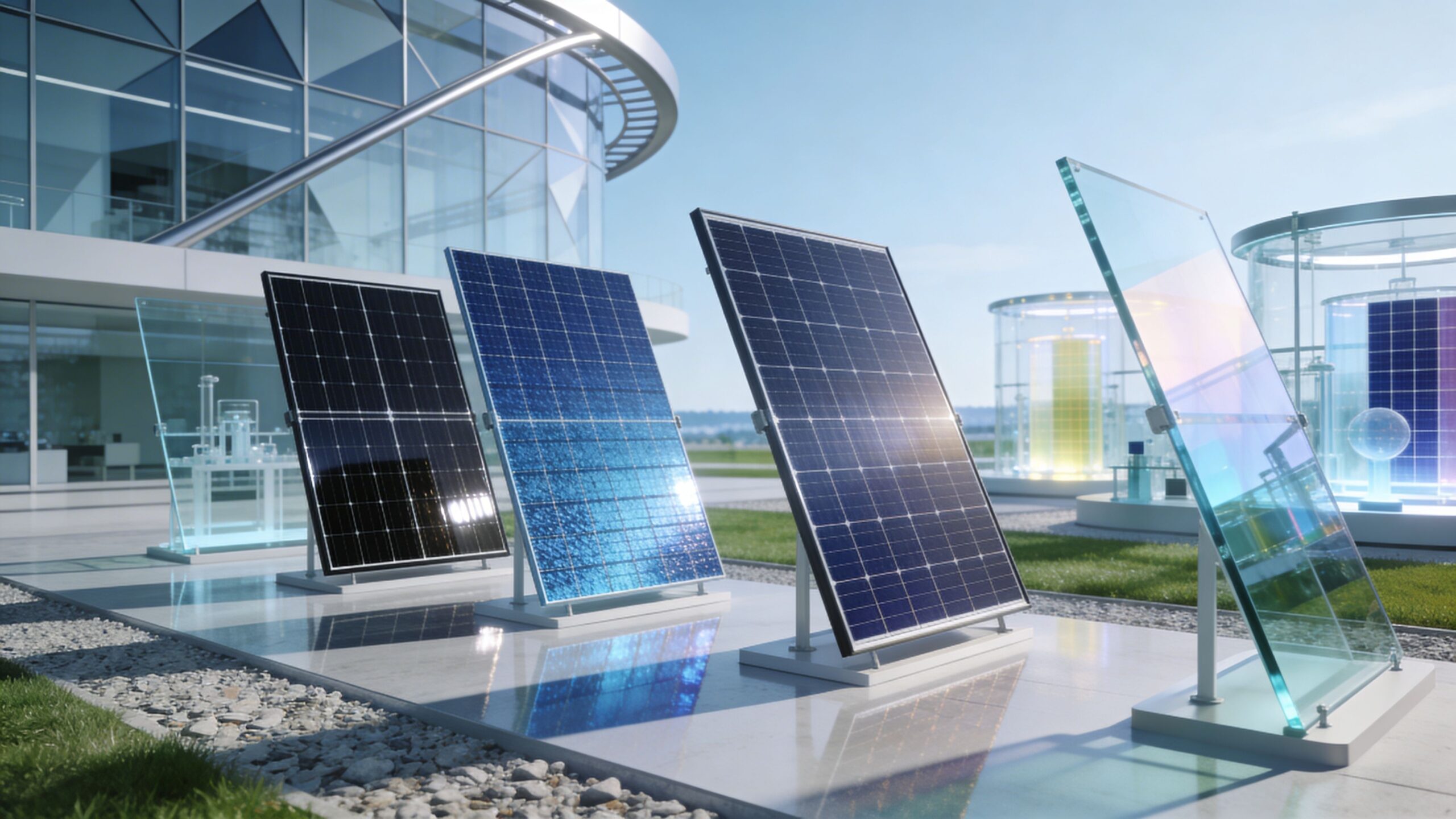
There is no universal winner because solar projects do not all have the same priorities. Monocrystalline silicon is usually the strongest fit when roof space is limited and buyers want proven efficiency with a clean appearance. Polycrystalline can still make sense where budget matters and space is available. Thin-film panels become attractive when flexibility, light weight, or design integration matters more than squeezing out the highest wattage per square foot. Perovskite remains the technology to watch if you care about the future of solar innovation. The better question is not simply which type is best, but best for what. Best for a suburban roof may not be best for a commercial façade. Best for a utility project may not be best for a portable product. Solar technology is a toolkit, and each panel type is built for a different balance of performance, cost, and design opportunity.
The Future of Solar Panel Technology
The future of solar will likely be shaped by both refinement and disruption. Silicon continues to improve through better cell architecture, module design, and manufacturing scale. Thin-film continues to expand where conventional panels face limits. Perovskite research continues to push boundaries in efficiency and opens the possibility of lower-cost, high-performance tandem solar products. DOE and NREL both frame the field as one where advanced silicon, thin-film innovation, and tandem technologies are all moving forward together rather than as a simple one-winner race.
That is what makes this moment so exciting. Solar is no longer just one mature technology repeating itself. It is a broad, evolving field where established materials and emerging discoveries are working side by side. For anyone building content around Solar Technology & Innovation, that mix of proven performance and next-generation possibility is exactly what makes the category so compelling.
Final Thoughts
From silicon to perovskite, the story of solar panels is really a story about tradeoffs and progress. Silicon remains the reliable workhorse of the industry. Thin-film adds flexibility and design freedom. Perovskite brings speed, research momentum, and the promise of a new leap forward. Together, they show how solar technology can evolve without abandoning the strengths that got it this far. For beginners, the most important takeaway is simple: solar panels are not all the same, and that is a good thing. The variety exists because different projects need different solutions. Once you understand the main categories, you can look at solar not as a confusing wall of technical terms, but as a fascinating landscape of energy tools built for the modern world.