The New Business Case for Solar
A commercial solar system is more than a line item on a sustainability report. For many companies, it has become a strategic upgrade—one that can reduce operating costs, stabilize long-term energy budgets, and strengthen resilience in an increasingly unpredictable energy landscape. Electricity is a persistent expense that touches nearly every business function, from lighting and HVAC to refrigeration, computing, manufacturing equipment, and EV charging. When power prices climb, margins shrink. When outages happen, productivity stalls. Solar gives businesses a tool to take back some control. What’s changed in the last decade is not simply that solar “works.” It’s that solar works at scale, with better financing options, stronger warranties, improved monitoring, and a clearer path from feasibility study to a system that starts producing savings immediately. Whether you’re running a small office building or managing a multi-site operation, commercial solar can be tailored to your load profile, roof space, land availability, and risk tolerance. This guide walks you through the entire commercial solar journey: how systems work, what they cost, how incentives and financing shape the economics, what installation looks like, and how businesses evaluate return on investment.
A: No. Nighttime power comes from the grid, a battery, or another energy source.
A: Yes, but production is usually lower than it is under strong direct sunlight.
A: Not always. Many systems are grid-tied without batteries, while backup designs need storage or another backup source.
A: Many panels are designed for decades of service, with gradual output loss over time.
A: Sometimes it can reduce energy charges greatly, but fixed fees, seasonal use, and utility rules still matter.
A: Standard grid-tied systems usually shut down unless approved backup equipment is installed.
A: It should be checked carefully because roof replacement after installation can require panel removal and reinstallation.
A: They can help when space is limited, but cost, warranty, layout, and total production matter too.
A: Owners usually watch monitoring, keep panels reasonably clear, and arrange service when output or equipment looks abnormal.
A: Review energy use, roof condition, shade, utility rules, goals, and realistic budget before comparing systems.
What Counts as “Commercial Solar”?
Commercial solar refers to photovoltaic (PV) systems installed for businesses and organizations—offices, warehouses, retailers, manufacturers, farms, schools, municipalities, and more. The technology is the same as residential solar: panels convert sunlight into electricity. The difference is scale and complexity. Commercial systems are usually larger, connect to more robust electrical infrastructure, and often must account for demand charges, time-of-use rates, and utility interconnection rules that can be more nuanced than a typical home setup.
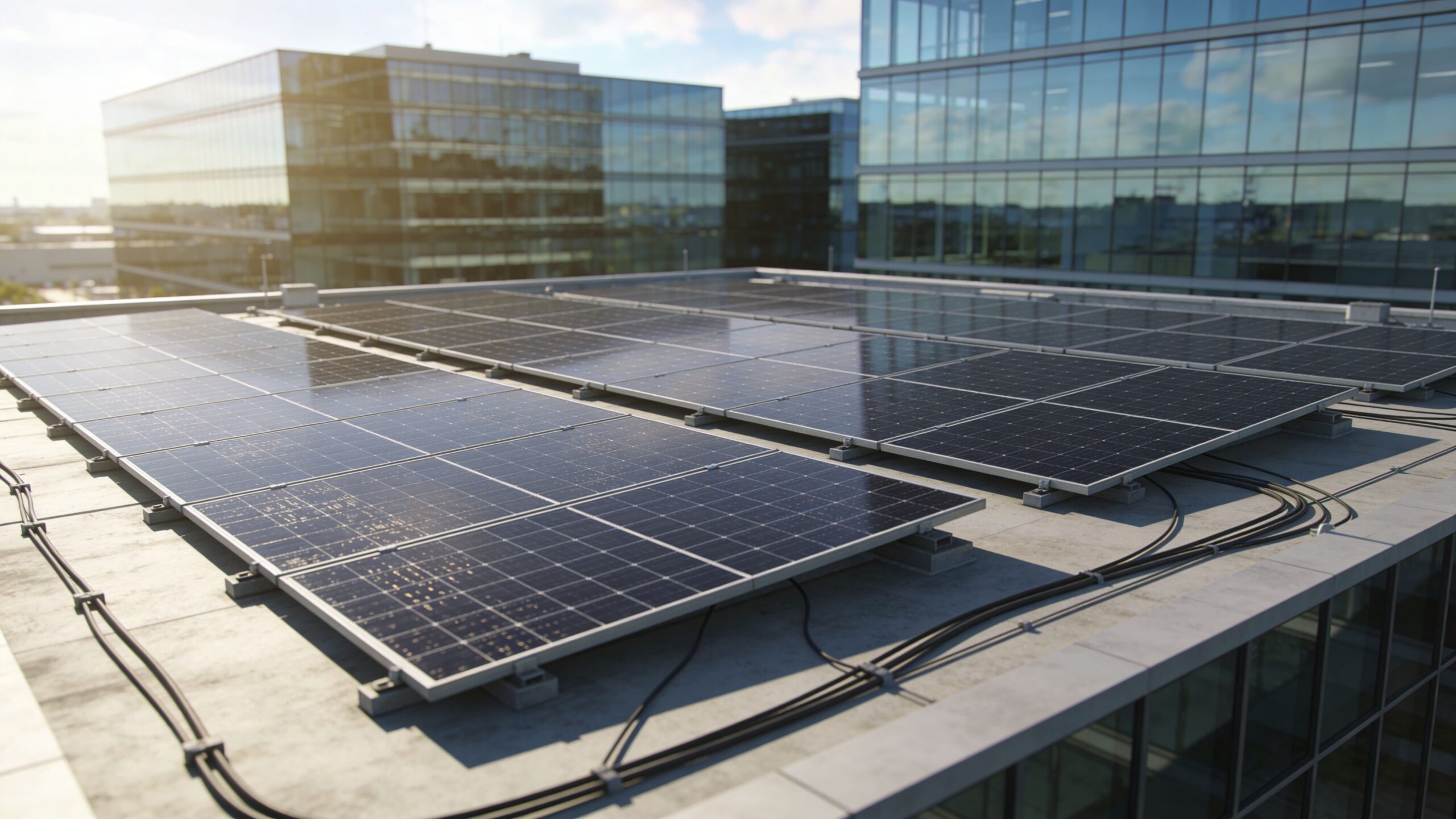
Commercial solar can be installed in several ways. Rooftop solar is the most common, especially for flat-roof buildings with unobstructed space. Solar carports—panels mounted as canopies over parking lots—are popular for businesses that want to generate power while adding shade and weather protection. Ground-mounted arrays are used when land is available and rooftops are unsuitable or already crowded with equipment.
The goal is usually to offset a meaningful portion of electricity use. Some businesses aim for a high percentage of onsite generation. Others focus on shaving peak costs, improving predictability, and building a portfolio of energy upgrades that includes efficiency improvements, storage, and load management.
How Commercial Solar Works: The Simple Version
Commercial solar is basically a small power plant attached to your building. When sunlight hits the panels, they generate direct current (DC) electricity. Inverters convert that DC power into alternating current (AC) electricity—the kind your building uses. Your facility consumes that solar power first because it’s produced onsite and enters your electrical system directly. If solar isn’t producing enough at that moment, your building automatically pulls the rest of the needed electricity from the utility grid.
When solar produces more than your building is using, the excess electricity can often flow back to the grid. Depending on local rules, you may receive credits for that exported energy. Those credits can reduce your bill later when solar production drops, such as in the evening or early morning. All of this happens automatically, continuously, and without the building “noticing” in any operational sense—except that the electric bill tends to get smaller.
The Core Components of a Commercial Solar System
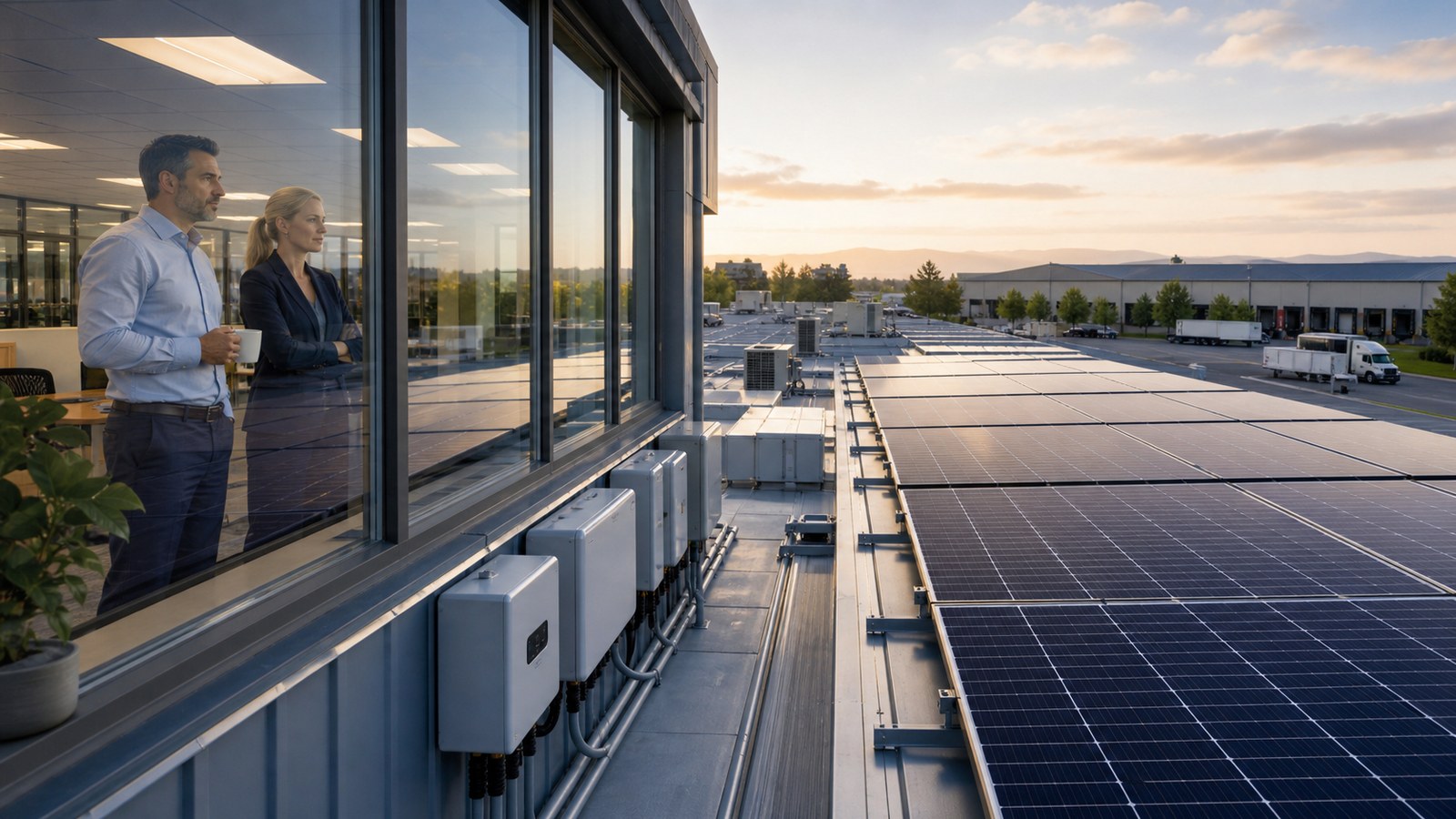
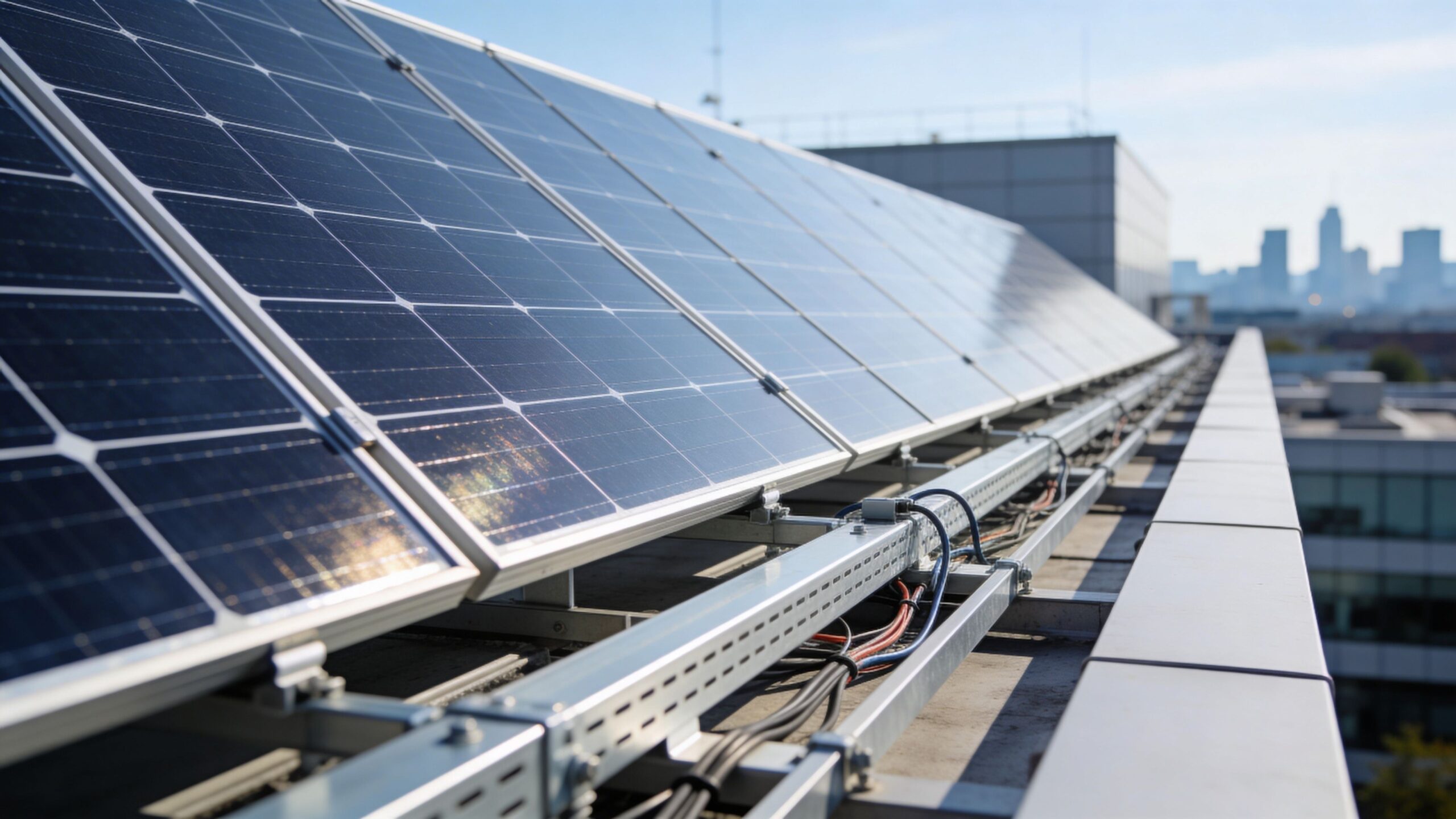
A commercial solar system is built from a few key parts, each with an important job. Solar panels are the visible part, but they’re only one piece of a larger engineered system. The racking and mounting hardware secures panels against wind and weather while protecting the roof. Electrical wiring and conduit safely route power from the array to inverters and then into your building’s distribution equipment. Inverters convert power and provide safety controls. Monitoring systems report production and alert operators if anything underperforms.
Bigger systems may include transformers, switchgear, combiner boxes, and production meters. Some projects include battery storage, which can store solar energy and discharge it when electricity is more expensive or when the grid is down. Others integrate energy management software to coordinate solar production with building loads and time-based rate structures. For businesses, the practical takeaway is that commercial solar is a designed system, not a “product.” The best systems are tailored to your building, your electricity usage patterns, and your utility’s pricing and interconnection rules.
Understanding Your Electric Bill: The Hidden Key to Solar Savings
Many businesses think solar savings are simply “how many kilowatt-hours you produce times the electricity price.” That’s part of it, but commercial bills often include additional cost layers. Demand charges, for example, can be a significant portion of monthly costs. Demand charges are based on your highest power draw over a short interval during the billing period—essentially the biggest spike in your electricity use.
Solar can reduce demand charges if it produces strongly during the times your building hits peak demand. It can also reduce energy charges by lowering the amount of electricity you buy from the grid. In regions with time-of-use pricing, solar can be especially valuable if it offsets energy during expensive daytime hours. Because billing structures vary by region and utility, the best commercial solar proposals include a tariff analysis. A system that produces slightly less total energy might still deliver higher savings if it better matches your building’s highest-cost hours.
Net Metering and Export Credits: What Happens to Extra Power?
Export credit policies vary, but the basic concept is this: if your system produces more electricity than you’re using at a given moment, that extra power may flow to the grid. Under traditional net metering, exported electricity can earn credits that offset electricity you import later. Under net billing or other programs, exports might be credited at a different rate.
For many businesses, the design goal is to maximize “self-consumption,” meaning your building uses most of the solar energy as it’s generated. That’s often the highest-value outcome, especially if export credits are lower than retail electricity rates. System sizing and operational strategies can be adjusted to reduce exports and increase onsite usage. The big beginner lesson here is that export rules affect the ideal system size. More panels are not always better if they produce energy that gets credited at a low rate.
How Much Does Commercial Solar Cost?
Commercial solar costs are typically discussed in terms of dollars per watt installed, but your real decision should be based on net cost after incentives and projected savings over time. Costs depend on system size, roof condition, structural requirements, electrical upgrades, equipment choices, permitting complexity, and labor. Larger systems usually cost less per watt because of economies of scale. Rooftop arrays can be cost-effective because they use existing space. Carports can cost more due to steel structures and foundation work, but they add valuable parking-lot functionality. Ground mounts vary based on site grading, trenching, and land constraints. The most useful way to think about cost is as an investment: what is the upfront or financed expense, what incentives reduce that expense, and how much do you save each year? The answers to those questions shape payback period and return on investment.
Incentives, Tax Credits, and Depreciation: Why Solar Often Pays Back Faster Than Expected
Commercial solar economics can improve dramatically through incentives. In many regions, businesses may qualify for tax credits, rebates, and accelerated depreciation that reduce effective costs and improve cash flow. Incentive structures vary by location and can change over time, but they often represent a major portion of a project’s financial story. Accelerated depreciation is particularly significant for businesses because it allows solar equipment to be written off more quickly than many other capital investments. Combined with tax credits, depreciation can shorten payback and increase overall returns. Because incentive eligibility depends on business structure, tax appetite, and program rules, many companies involve both the solar provider and a tax professional to model the benefits accurately.
Financing Options: Buying, Leasing, and Power Purchase Agreements
Commercial solar doesn’t have to be paid for entirely upfront. Financing options make solar accessible for businesses that prefer to preserve capital or maintain flexibility. A direct purchase gives you the highest long-term savings because you own the asset and capture incentives directly. A solar loan spreads costs over time, ideally with payments that are offset by monthly energy savings. A lease provides fixed payments and often shifts maintenance responsibilities to the provider.
A power purchase agreement (PPA) is another common model. With a PPA, a third party owns and maintains the system, and your business buys the electricity it produces at an agreed rate—often lower than the utility price. This can reduce costs with minimal upfront expense, though the long-term savings may be lower than owning the system outright. Financing choice often comes down to your goals: maximize long-term savings, minimize upfront investment, reduce operational complexity, or prioritize balance-sheet considerations.
The Installation Process: What to Expect From Start to “Permission to Operate”
Commercial solar projects typically begin with a site and energy assessment. The provider reviews your electricity usage history, rate plan, roof condition, shading, and electrical infrastructure. This leads to system sizing, preliminary design, and savings projections. Next comes engineering. Structural engineers verify roof capacity and wind loading. Electrical engineers design safe integration with your building systems. Permits are obtained from local authorities, and the project is submitted to the utility for interconnection approval. For many commercial projects, utility approvals can influence timelines as much as construction.
Installation includes mounting racking, placing panels, running wiring, installing inverters, integrating monitoring, and connecting the system to your building’s electrical service. After installation, inspections occur, and the utility grants permission to operate. Once granted, the system begins producing electricity immediately. A well-managed project minimizes disruptions. Most rooftop work happens away from customer-facing areas, and electrical tie-ins are scheduled to avoid operational interruptions when possible.
Maintenance and Performance: How Solar Becomes a “Quiet Asset”
Solar is popular partly because it’s low maintenance. Panels have no moving parts. Routine needs typically include periodic inspections, reviewing monitoring data, and cleaning panels when local conditions cause heavy dust or buildup. Inverters are often the component most likely to need replacement during a system’s life, commonly around the 10–15 year mark depending on type. Panels degrade slowly over time, meaning output gradually declines rather than dropping suddenly. Monitoring systems make maintenance easier by providing alerts when production deviates from expected output. Many businesses choose service agreements that include performance monitoring, inspections, and repair response, turning solar into a predictable, managed asset.
Adding Battery Storage: When It Makes Sense for Businesses
Battery storage can turn a solar project into a more flexible energy system. Batteries store excess solar generation and discharge it later when electricity is more expensive or when demand charges would otherwise spike. Storage can also support resilience by keeping critical systems running during outages—if the system is designed for backup. Storage is most compelling when demand charges are high, time-of-use pricing creates expensive evening windows, or outages carry significant costs. It may be less financially compelling when tariffs are simple and export credits are generous. The best approach is to evaluate storage as a separate layer: solar first, then storage if your rate structure and operational priorities justify the added investment.
ROI and Payback: How Businesses Measure Success
Commercial solar ROI is usually evaluated through payback period, lifetime savings, and sometimes internal rate of return. Payback period is the simplest: how long it takes for savings to equal the net cost of the system after incentives. After payback, the system continues producing lower-cost electricity for many years. Because commercial systems often operate 25–35 years, the post-payback period can generate substantial cumulative savings. Many companies also see value beyond direct ROI. Solar can improve long-term budget predictability, support sustainability commitments, strengthen brand positioning, and reduce exposure to utility rate increases. For some businesses, that stability is as valuable as the raw savings.
Choosing a Commercial Solar Partner: What Matters Most
A strong commercial solar outcome depends heavily on project development quality. Good providers perform honest site assessments, model savings based on your actual rate plan, and design systems that prioritize long-term reliability. They also manage permitting and interconnection efficiently, provide clear warranty information, and offer monitoring and service support that match your operational expectations. For beginners, the most important thing is transparency: clear assumptions, clear projections, and clear responsibilities after installation. Solar should feel like a managed investment, not a mystery box.
Final Thoughts: Solar as a Long-Term Business Advantage
Commercial solar is no longer a futuristic experiment. It’s a proven energy strategy that helps businesses reduce costs, gain predictability, and demonstrate leadership in sustainability. The technology is straightforward: panels generate DC electricity, inverters convert it to AC, your building uses solar power first, and the utility connection fills the gaps and may credit exports. The benefits come from smart design, careful tariff analysis, and an approach that aligns with your business goals. For many businesses, solar is one of the rare upgrades that can improve both financial performance and public perception while quietly working every sunny day for decades.